
Article
US clears $24.3bn stealth fighter sale to Saudi Arabia and says Israel's edge will hold
Riyadh would be the first Arab operator of America's most advanced stealth jet, but the finding rests on classified downgrades, basing limits and compensation for Israel that analysts and Israel's air force dispute, as US intelligence warns Saudi ties to China risk exposing stealth secrets — Congress has 30 days to try to block it.


Pictures in this frame are AI-generated, not photographs.
What happenedThe State Department notified Congress of a possible 48-jet F-35A package for Saudi Arabia valued at $24.3 billion, starting a 30-day review before any contract can be negotiated.
Why it mattersIf concluded, Riyadh would be the first Arab operator of America's most advanced stealth fighter, testing a US law protecting Israel's military edge, raising US intelligence warnings about stealth secrets reaching China, and setting a precedent Qatar, the UAE and Turkey are already citing.
Still openWhether undisclosed mitigations — less-capable jets, basing limits and added capabilities for Israel — actually preserve Israel's legally required edge, and whether Congress will try to block the sale and sustain a veto override.
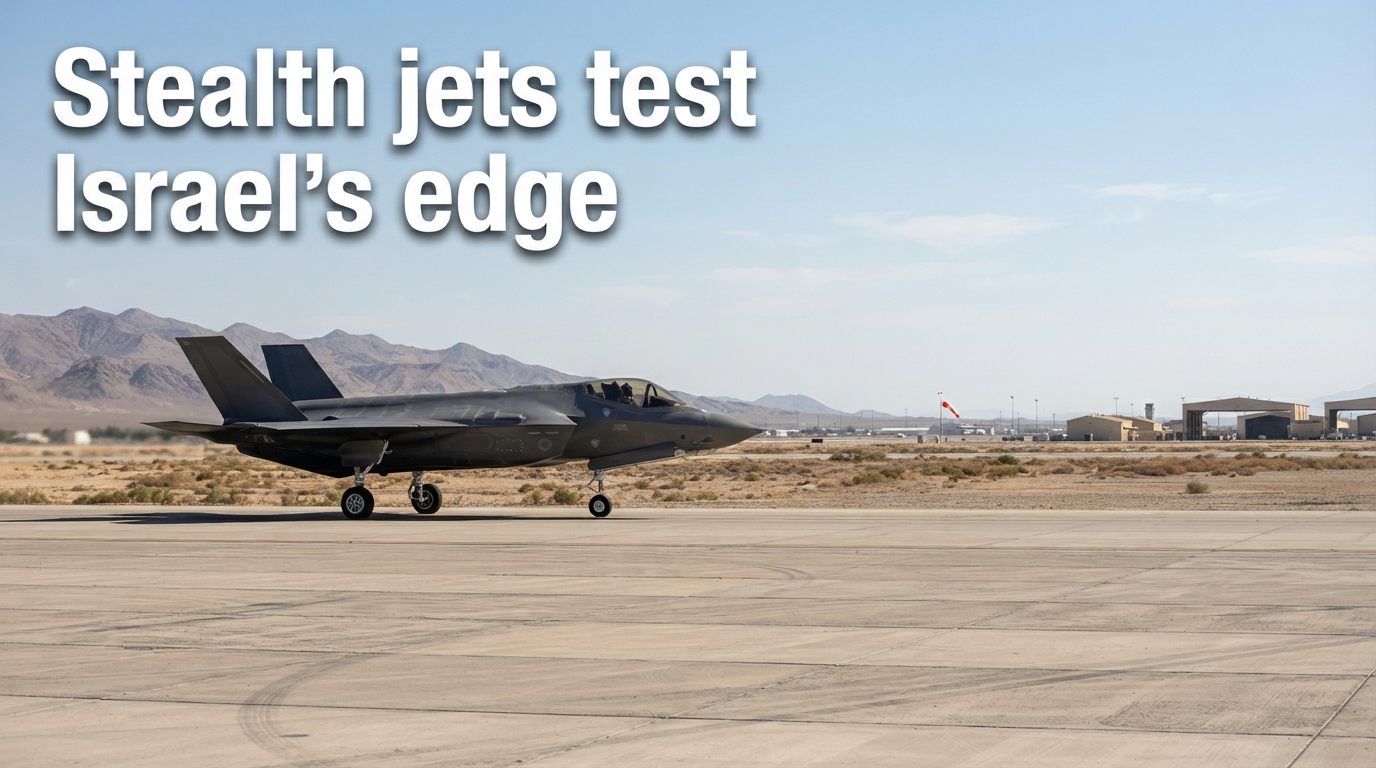
On Sept 17, 2026, the U.S. State Department approved a possible $24.3 billion sale of 48 F-35A stealth fighters to Saudi Arabia and notified Congress for a 30-day review. If concluded, it would make Saudi Arabia the first Arab state to fly America's most advanced stealth fighter — Israel is currently the only operator in the Middle East — and it tests two separate American promises: a law that guarantees Israel's military edge, and a warning from U.S. intelligence that the same jets could expose stealth secrets to China. Whether either holds depends on classified mitigations no outsider can verify and on whether Congress tries to block the deal.
How 48 F-35s would change Saudi Arabia's fighter fleet, and how that lot compares to the worldwide F-35 program. Adding 48 F-35As would take the Royal Saudi Air Force from about 385 combat aircraft (232 F-15s, 72 Typhoons, 81 Tornados) to 433 if those types all stay — a 12.5% increase, or about 15% of the 304 fighters that would remain if the Tornados retire. The same 48-jet lot is smaller than Israel's 75 ordered F-35Is (42–45 already flying) and the UAE's 2020 notice for 50 (none delivered), and it is about 4% of the 1,200-plus F-35s already operating worldwide and 2% of the 2,454 aircraft the United States plans to buy. The $24.3 billion package is roughly $506 million per jet including support, versus about $82 million for a recent-lot airframe without the engine; as of 18 September 2026 this is a proposed Foreign Military Sale, not a delivery. — AI-assisted analytic, built only from real cited or sourced data. Source: The Aviationist, Defence Industry Europe (summarizing FY2027 MSAR), Lockheed Martin. As of 2026-09-18.
The jet at the center is the F-35 Lightning II, America's most advanced stealth fighter, built to evade radar, fuse sensor data and fight networked. The buyer is the Royal Saudi Air Force, which today flies mostly American F-15s, European Typhoons and aging Tornados it wants to replace. The process is a Foreign Military Sale, the government-to-government system in which the State Department approves a possible package, Congress gets a review window, and only then do the U.S. and the buyer negotiate a final contract. Approval is not delivery.
What $24.3 billion actually buys
The notice, Transmittal No. 26-69, lists 48 F-35A aircraft — the conventional-takeoff version that uses normal runways — and 49 Pratt & Whitney F135-PW-100 engines, 48 installed plus one spare. The rest is the long tail that makes a stealth fleet work: key loaders, cryptographic appliques, secure communications and navigation gear, electronic-warfare database support, spares, repair and return, training aids and simulators, software and publications, ferry and refueling, site surveys and U.S. government engineering support.
That is why the price looks so high. The $24.3 billion is an estimated total package, not a sticker price for 48 airframes and not a final contract. The same figure — $24.3 billion — was the price for 296 F-35 airframes alone in the Lots 18-19 production contract definitized in September 2025, at an average of about $82 million per airframe before engines. The Saudi package works out to roughly $506 million per aircraft once engines, spares, training and support are included, which is typical for a Foreign Military Sale. The State Department said there is no known offset agreement and no additional U.S. personnel would be required in Saudi Arabia.
Scale helps place it. Forty-eight jets would be about a 15% increase to Saudi Arabia's roughly 385 fighters, but about 2% of the planned U.S. program of 2,454 aircraft and about 4% of the more than 1,200 F-35s already operating from 48 bases and 12 ships in 20 nations. At the recent production pace of 191 deliveries in 2025, 48 jets is roughly a third of a year's output. First deliveries, if the sale survives review and contracting, would still be years away; no lot assignment or delivery date was published.
Why basing F-35s away from western Saudi Arabia matters for Israel's edge. Tabuk, in northwestern Saudi Arabia, sits 445 km from Tel Aviv — a short hop for an F-35 — while Riyadh is about 1,430 km away. That gap is why Israeli conditions on a Saudi F-35 sale have focused on keeping the jets off western bases near Israel. City points are Natural Earth 50m populated-place centroids the kilometre figures are WGS84 great-circles between those points, not flight paths, and the amber wash marks the Tabuk region rather than any mapped airbase. — AI-assisted analytic, built only from real cited or sourced data. Source: Axios, Responsible Statecraft / Quincy Institute, gov. As of 2026-09-18.
The legal promise: 'will not alter the military balance'
Every U.S. arms notice for the region carries the same line, and this one did too: the proposed sale "will not alter the military balance in the region."
That sentence is not a press line. It is the public face of a classified test required by U.S. law. Since the Naval Vessel Transfer Act of 2008, codified as Section 36(h) of the Arms Export Control Act (22 USC 2776(h)), the president must ensure that arms exports to the Middle East do not adversely affect Israel's Qualitative Military Edge — defined in law as Israel's ability to counter and defeat credible conventional threats from any state, coalition or non-state actor while sustaining minimal damage, through superior weapons and other capabilities in sufficient quantity. Assessments are required biennially since 2013.
The analysis itself is classified and interagency — State, the Defense Security Cooperation Agency, the Joint Staff, the intelligence community and combatant commands — with Israeli input through the Joint Political Military Group. After the Sept 17 transmittal, Prime Minister Benjamin Netanyahu said Secretary of State Marco Rubio had reiterated in a phone call that Washington is committed to preserving Israel's edge "in everything related to supplying weapons and military systems to countries in the Middle East" and that the advantage is legally guaranteed. U.S. officials indicated Saudi jets would be less advanced than Israel's and limited to two squadrons.
Why that promise is contested
The same sentence that satisfies the law is also why many analysts do not trust it. The "will not alter the balance" language is routine boilerplate that appears in every DSCA notification — for Taiwan, Pakistan, Greece and others — intended to pre-empt congressional objections, not an independently verifiable finding.
The Israeli Air Force itself submitted a formal position paper warning that a Saudi acquisition of up to 48 F-35s could "erode or significantly degrade" Israel's edge and regional air superiority, citing the jet's advanced detection, data-processing and networked systems.
Independent analysts made the same point in blunter terms. Eric Mandel assessed that "even a slightly downgraded fifth-generation F-35 in Saudi hands would be a strategic game-changer" and that Israeli Air Force and U.S. intelligence and defense officials believe it would undermine Israel's dominance of regional airspace. Yoel Guzansky, head of the Gulf program at Israel's Institute for National Security Studies, said "The state of Israel's QME is not as good as it was before Trump's decision" and warned of an arms race with Qatar, the United Arab Emirates and Turkey. Former national security adviser Yaakov Amidror said a jet in another Middle East country's hands "will be problematic, because we will lose some uniqueness." A Hudson Institute assessment called the sale a "turning point for airpower dynamics in the Middle East."
Washington's answer, as reported rather than confirmed in the unclassified notice, is a bundle of mitigations that could square the circle without breaking the law. Saudi jets would be downgraded relative to Israel's F-35I Adir — Israel flies the only F-35 variant contractually authorized for deep indigenous integration, with its own electronic-warfare suite, command-and-control, weapons and software, and independent sustainment. Israel has ordered 75 F-35Is and operates 42 to 45 of the first 50, with the rest due through 2028. Other reported mitigations include capping the sale at two squadrons, barring basing at western Saudi airfields closest to Israel, compensating Israel with additional capabilities, and stretching deliveries over five to ten years. None of those details are confirmed in the public transmittal, and the classified QME analysis cannot be independently checked.
That creates the perverse incentive critics flag. Compensating Israel to preserve the legal edge can fuel a regional arms race — in tension with the Arms Export Control Act's own policy to discourage arms races — while denying or limiting the sale to preserve the edge can push Gulf buyers toward China or Russia, which are not bound by QME at all.
A separate warning: China and the stealth secrets
Distinct from the Israel debate is the intelligence community's objection. Assessments from the Defense Intelligence Agency in fall 2025 and broader intelligence reporting in September 2026, reported by The New York Times, warned that Beijing could gain access to sensitive F-35 technology through traditional espionage in Saudi Arabia or through deepening Saudi-China military and telecom ties. Saudi telecom infrastructure heavily uses Chinese equipment, and China has helped Saudi missile production, including solid-rocket fuel and past sales of DF-3 and DF-21 ballistic missiles, plus Wing Loong II and CH-4 drones.
The DIA warning is a risk assessment, not an established breach, and it does not assert that specific U.S. controls have been decided. Proponents of the sale make the opposite case: supplying the jets with U.S. monitoring is preferable to pushing Riyadh toward Chinese or Russian alternatives, and Saudi F-35s would be cloud-dependent and less capable than Israel's independently sustained Adirs.
The check that still matters: 30 days in Congress
Approval did not make the sale final. The DSCA notification triggered a 30-day congressional review period — 15 days for some NATO-plus cases, 30 for Saudi Arabia. Congress can introduce a joint resolution of disapproval; passage requires simple majorities, but a presidential veto then requires two-thirds in both chambers to override, a historically high bar.
Most arms sales are uncontroversial. An F-35 sale to Saudi Arabia draws greater scrutiny, especially after the intelligence warnings, plus longstanding human-rights and Yemen concerns. No resolution has been filed and no whip count published. The outcome remains open.
Why Riyadh wants it now, and why Washington wants to sell
For Saudi Arabia, the jets would replace about 81 Tornado IDS aircraft being phased out and complement about 232 F-15s and 72 Typhoons, under the Vision 2030 modernization drive. Drivers cited are deterrence against Iran and renewed fighting with the Houthis, and interoperability with U.S. and NATO forces.
Timing follows politics. President Donald Trump announced in November 2025, ahead of a White House meeting with Crown Prince Mohammed bin Salman, that he would approve F-35s for Saudi Arabia, alongside a Strategic Defense Agreement that also included about 300 M1 Abrams tanks. A full-scale F-35A mockup in Saudi markings was displayed at the World Defense Show in February 2026. Biden-era talks that linked jets to a broader U.S.-Saudi security pact and potential Saudi-Israeli normalization stalled after the Oct. 7, 2023 Hamas attack and the Gaza war.
For Washington, the sale is also about outcompeting China and Russia and building an anti-Iran architecture. The precedent cuts both ways. In November 2020 the Trump administration notified Congress of 50 F-35s for the United Arab Emirates, a $23.37 billion package with MQ-9Bs and munitions offered as an unwritten sweetener for joining the Abraham Accords — the U.S.-brokered deals since 2020 in which Arab states normalized relations with Israel. That sale was paused under President Joe Biden and has not delivered as of 2026.
Israeli officials have reportedly wanted the Saudi sale conditioned on Riyadh joining the Accords, while Saudi Arabia has demanded a credible path to a Palestinian state. The sale as notified is not explicitly conditioned on normalization, and Trump did not tie it to a peace deal even as he urged the crown prince toward one. Approving without that condition, critics warn, forfeits leverage that made the UAE offer meaningful and increases proliferation pressure as Qatar, the UAE and Turkey cite the precedent. Saudi Arabia, meanwhile, hedges with alternatives including a Boeing F-15EX upgrade, interest in Turkey's Kaan fighter, and continued Chinese missile cooperation.
If the deal proceeds, Saudi Arabia would be the first Arab F-35 operator and the second in the Middle East after Israel. Whether the jets arrive downgraded, distant from Israel's border, and late enough to preserve a legal edge — and whether U.S. controls keep their secrets from Beijing — will be decided in the classified details and the next 30 days on Capitol Hill, not in the boilerplate.
Source recordSources / claims / limits
How this piece is framed: A contested assurance: Washington says 48 stealth jets for Saudi Arabia won't tip the Middle East balance — the law, the fine print, and the warnings say it's more complicated
Charts & tables — AI-assisted; provenance on each line
- 48 jets is a big step for Saudi Arabia, a small slice of the global F-35 fleet — from claims clm_93680f17d2, clm_8d71797cac, clm_9072b81a3f, clm_3b1135ddac, clm_2bb697fef9, clm_40c855fb6e · as of 2026-09-18
- The geography behind the 'will not alter the balance' claim — sourced for this figure · as of 2026-09-18
Sources
- (primary) 22 USC 2776: Reports and certifications to Congress on military exports (Arms Export Control Act Sec 36) — gov — https://uscode.house.gov/view.xhtml?req=granuleid:USC-prelim-title22-section2776&num=0&edition=prelim · read in full · captured 2026-09-18
- (primary) Netanyahu brushes off Saudi F-35 deal, says US will ensure Israel's military edge — gov — https://www.timesofisrael.com/netanyahu-brushes-off-saudi-f-35-deal-says-us-will-ensure-israels-military-edge · read in full · captured 2026-09-18
- (primary) Kingdom of Saudi Arabia – F-35 Lightning II Joint Strike Fighter Aircraft — U.S. Department of State, Bureau of Political-Military Affairs — https://www.state.gov/releases/bureau-of-political-military-affairs/2026/09/kingdom-of-saudi-arabia-f-35-lightning-ii-joint-strike-fighter-aircraft · read in full · captured 2026-09-17
- (primary) F-35 Deal for Lots 18 and 19 Covers 296 Fighters at $24.3 Billion — gov — https://www.airandspaceforces.com/f-35-lots-18-and-19-contract · read in full · captured 2026-09-18
- (primary) JPO and Lockheed Martin Finalize F-35 Contract for Lots 18 and 19 — gov — https://theaviationist.com/2025/09/30/f-35-contract-lots-18-and-19 · read in full · captured 2026-09-18
- (primary) Israel to add 25 more F-35s under latest $3bn deal — gov — https://www.flightglobal.com/fixed-wing/2024/06/israel-to-add-25-more-f-35s-under-latest-3bn-deal · read in full · captured 2026-09-18
- (primary) Lockheed Martin awarded contract to advance software modifications for Israel's F-35I Adir fleet — gov — https://defence-industry.eu/lockheed-martin-awarded-contract-to-advance-software-modifications-for-israels-f-35i-adir-fleet · read in full · captured 2026-09-18
- (primary) WATCH: IDF strengthens air dominance with latest F-35 arrivals — gov — https://www.jpost.com/israel-news/article-846278 · read in full · captured 2026-09-18
- (secondary) Does Israel really still need a 'qualitative military edge' ? — Responsible Statecraft / Quincy Institute — https://responsiblestatecraft.org/israel-qualitative-military-edge · read in full · captured 2026-09-17
- (secondary) Saudi F-35 sale triggers Israeli concern, though military edge may remain intact — Times of Israel — https://www.timesofisrael.com/saudi-f-35-sale-triggers-israeli-concern-though-military-edge-may-remain-intact · read in full · captured 2026-09-18
- (secondary) Trump administration approves $24B sale of F-35 jets to Saudi Arabia — Al-Monitor — https://www.al-monitor.com/originals/2026/09/trump-administration-approves-24b-sale-f-35-jets-saudi-arabia · read in full · captured 2026-09-17
- (secondary) Saudi Arabia's F-35 Push Advances After U.S.–Saudi Defense Pact — The Aviationist — https://theaviationist.com/2025/11/21/saudi-f-35-and-us-saudi-sda · read in full · captured 2026-09-18
- (secondary) F-35's $1.4 trillion sustainment bill, rising modernization costs and production strain test the limits of global fleet expansion — Defence Industry Europe (summarizing FY2027 MSAR) — https://defence-industry.eu/f-35s-1-4-trillion-sustainment-bill-rising-modernization-costs-and-production-strain-test-the-limits-of-global-fleet-expansion · read in full · captured 2026-09-17
- (secondary) U.S. approves sale of 48 F-35 jets to Saudi Arabia — The Hindu — https://www.thehindu.com/news/international/us-approves-sale-of-48-f-35-jets-to-saudi-arabia/article71478233.ece · read in full · captured 2026-09-17
- (secondary) How US law protects Israel's Qualitative Military Edge — gov — https://www.middleeasteye.net/explainers/how-us-law-protects-israels-qualitative-military-edge · read in full · captured 2026-09-18
- (secondary) Greece Joins Switchblade Arsenal With $80.1M Deal as Aegean Tensions Rise — TechTimes — https://www.techtimes.com/articles/321232/20260721/greece-joins-switchblade-arsenal-801m-deal-aegean-tensions-rise.htm · read in full · captured 2026-09-18
- (secondary) Is Israel's F-35 Qualitative Military Edge DOA after Saudi announcement? — Breaking Defense — https://breakingdefense.com/2025/11/is-israels-f-35-qualitative-military-edge-doa-after-saudi-announcement · read in full · captured 2026-09-18
- (secondary) The Saudi F-35 Gambit: A High-End Arms Sale Meets Middle Eastern Geopolitics — Hudson Institute — https://www.hudson.org/politics-government/saudi-f-35-gambit-high-end-arms-sale-meets-middle-eastern-geopolitics-can-kasapoglu · read in full · captured 2026-09-18
- (secondary) Saudi Arabian Military's Modernization in the Spotlight at World Defense Show — The Aviationist — https://theaviationist.com/2026/02/10/saudi-arabian-military-world-defense-show · read in full · captured 2026-09-17
- (primary) F-35 Breaks Delivery Record, Continues Combat Success in 2025 — Lockheed Martin — https://news.lockheedmartin.com/2026-01-07-F-35-Breaks-Delivery-Record,-Continues-Combat-Success-in-2025 · full text not obtained — used its summary
- (secondary) F-35 Blueprints Leaked, J-20 Flies On Stolen Tech: Why Is U.S. Further Compromising F-35's Secrets With Saudi Deal? — EurAsian Times — https://www.eurasiantimes.com/f-35-blueprints-leaked-secrets-with-saudi-deal · full text not obtained — used its summary
- (secondary) U.S. will sell Saudi Arabia advanced F-35 fighter jets, Trump says — Axios — https://www.axios.com/2025/11/17/saudi-f35-trump-mbs-meeting · full text not obtained — used its summary
- (secondary) US Intel Raises China Espionage Concerns Over Saudi F-35 Deal - Report — i24NEWS (summarizing NYT) — https://www.i24news.tv/en/news/international/americas/artc-us-intel-raises-china-espionage-concerns-over-saudi-f-35-deal-report · full text not obtained — used its summary
Claims, and how far we tracked each down
- [confirmed] U.S. State Department made determination approving possible Foreign Military Sale to Saudi Arabia for F-35 Lightning II and related equipment with estimated total cost $24.3 billion (Transmittal #26-69) on Sept 17, 2026 · read in full (as of 2026-09-17)
- [confirmed] Package includes 48 F-35 Lightning II Joint Strike Fighter aircraft with conventional takeoff and landing (F-35A) and 49 Pratt & Whitney F135-PW-100 engines (48 installed, 1 spare) · read in full (as of 2026-09-17)
- [confirmed] Non-MDE items include AN/PYQ-10 simple key loaders, KIV-78 cryptographic appliques, secure communications/precision navigation/cryptographic devices, electronic warfare database support, cartridge/propellant actuated devices, aircraft/munitions support equipment, spares, repair/return, training aids, engine component improvement program, modifications/maintenance, classified/unclassified software and publications, transportation/ferry/refueling, personnel training including simulators, clothing/textiles, studies/site surveys, and U.S. Government engineering/technical/logistics support · read in full (as of 2026-09-17)
- [confirmed] State Department notified Congress; sale proceeds through Foreign Military Sales process with 30-day congressional review period · read in full (as of 2026-09-17)
- [confirmed] Congress could block sale via joint resolution of disapproval; president could veto, requiring two-thirds majority in both chambers to override · read in full (as of 2026-09-17)
- [confirmed] State Department justification: sale supports U.S. foreign policy and national security by improving security of major non-NATO ally that is force for political stability and economic progress in Gulf; improves Saudi capability to deter current/future threats, strengthens homeland defense, improves interoperability with U.S./regional/NATO forces, augments operational aircraft and enhances air-to-air and air-to-ground self-defense capability · read in full (as of 2026-09-17)
- [confirmed] State Department stated proposed sale will not alter the military balance in the region · read in full (as of 2026-09-17)
- [confirmed] President Donald Trump announced in November 2025 he would approve F-35 sale to Saudi Arabia ahead of White House meeting with Crown Prince Mohammed bin Salman · read in full (as of 2026-09-17)
- [likely] Israel is currently the only Middle East country operating the F-35; Saudi Arabia would become first Arab state to acquire/operate the jet if sale concludes · read in full (as of 2026-09-17)
- [confirmed] U.S. law requires preservation of Israel's Qualitative Military Edge (QME), defined in 2008 Naval Vessel Transfer Act as ability to counter/defeat credible conventional threats while sustaining minimal damage via superior means; codified via Arms Export Control Act amendments requiring QME assessment for Middle East arms transfers · read in full (as of 2026-09-17)
- [likely] Israeli officials have not opposed sale in principle but sought conditions: aircraft not include most sophisticated systems available to Israel, not deployed to western Saudi bases near Israel, and linked to Saudi normalization with Israel under Abraham Accords framework · read in full (as of 2026-09-17)
- [likely] U.S. intelligence agencies (including Defense Intelligence Agency assessment fall 2025) warned China could gain access to sensitive F-35 technology via espionage in Saudi Arabia or via Saudi-China military/security and telecom infrastructure ties · read in full (as of 2026-09-17)
- [confirmed] Israel has ordered 75 F-35A aircraft converted to F-35I Adir configuration; currently operates 42-45 of initial 50 with staged deliveries to 50 by 2026 and 75 from 2027-2028; F-35I is the only F-35 variant contractually authorized for deep indigenous integration (Israeli EW suite, C2, weapons, software upgrade packages) funded by Israel via FMS with ~80% work in Fort Worth and remainder in Israel, providing independent sustainment not expected for Saudi Arabia · read in full (as of 2026-09-18)
- [confirmed] QME is defined in U.S. law as 'the ability to counter and defeat any credible conventional military threat from any individual state or possible coalition of states or from non-state actors, while sustaining minimal damages and casualties, through the use of superior military means, possessed in sufficient quantity, including weapons, command, control, communication, intelligence, surveillance, and reconnaissance capabilities that in their technical characteristics are superior in capability to those of such other individual or possible coalition of states or non-state actors' — codified in Section 36(h) of Arms Export Control Act (22 USC 2776(h)) via Naval Vessel Transfer Act of 2008 (P.L. 110-429 Sec 201), requiring President to ensure Middle East arms exports do not adversely affect Israel's QME and to conduct periodic assessments (quadrennial, amended to biennial in 2013) · read in full (as of 2026-09-18)
- [confirmed] In response to Transmittal 26-69 (Sept 17-18 2026), PM Netanyahu stated Secretary Rubio reiterated commitment that US will continue to preserve Israel's QME 'in everything related to supplying weapons and military systems to countries in the Middle East' and that advantage is legally guaranteed; government spokesperson Shosh Bedrosian cited 'long-standing understanding' QME will be preserved; U.S. officials indicated Saudi F-35s would be less advanced than Israeli F-35I Adir and limited to two squadrons · read in full (as of 2026-09-18)
- [confirmed] F-35 JPO and Lockheed Martin definitized Lots 18-19 contract Sept 29 2025 for 296 aircraft at $24.29B total ($11.8B Dec 2024 Lot 18 + $12.5B Sept 2025 modification), average airframe ~$82.1-82.4M excluding F135 engines contracted separately to Pratt & Whitney as government-furnished equipment; Lot 18 increased to 148 aircraft and Lot 19 adds 148 aircraft (including 52 F-35A +12 F-35B for FMS customers); Lot 19 production expected completed August 2028 with first deliveries in 2026; Saudi $24.3B for 48 jets +49 engines + support is FMS total package price, numerically identical to 296-airframe-only total, confirming extensive non-MDE tail · read in full (as of 2026-09-18)
- [confirmed] State's 'will not alter the basic military balance in the region' / 'will not alter the military balance' language is routine boilerplate present in every DSCA/State Transmittal notification, intended to pre-empt congressional objections rather than as independently verifiable analytical finding. Same phrasing appears for Taiwan, Pakistan, Greece and other sales. · read in full (as of 2026-09-18)
- [confirmed] Israeli Air Force submitted formal position paper / white paper to political leaders warning Saudi acquisition of up to 48 F-35s could 'erode or significantly degrade' Israel's qualitative military edge and regional air superiority, citing F-35's advanced detection, data-processing and networked systems. · read in full (as of 2026-09-18)
- [confirmed] Responsible Statecraft analysis argues QME requirement creates perverse incentives: (1) compensating Israel with additional capabilities to preserve QME can fuel regional arms race, potentially in tension with AECA Sec 36(b) arms-race assessment and AECA policy to 'discourage arms races'; (2) denying or limiting sales to preserve QME pushes Arab partners to shift defense supply chains to China or Russia, which are not bound by QME. · read in full (as of 2026-09-17)
- [confirmed] Credible Israeli and U.S. analysts dispute State's 'no change' determination: Eric Mandel assessed 'even a slightly downgraded fifth-generation F-35 in Saudi hands would be a strategic game-changer' and that IAF plus U.S. intelligence/defense officials believe sale would undermine Israel's military dominance and control of regional airspace; INSS Gulf head Yoel Guzansky stated 'The state of Israel's QME is not as good as it was before Trump's decision' and warned of arms race with Qatar, UAE and Turkey; former NSA Yaakov Amidror (JINSA/JISS) said plane in another Middle East country's hands 'will be problematic, because we will lose some uniqueness.' · read in full (as of 2026-09-18)
- [likely] Hudson Institute assessment frames Saudi F-35 sale as 'turning point for airpower dynamics in the Middle East' with 'severe implications for three key pillars' including preserving QME 'in a worsening threat landscape,' noting Israeli conditional openness tied to normalization reflects recognition outright rejection is no longer sustainable but safeguards/restrictions/reciprocity needed. · read in full (as of 2026-09-18)
- [likely] Experts warn sale to non-normalized Saudi Arabia forfeits expected Abraham Accords leverage (unlike UAE 2020 F-35 sweetener) and increases proliferation pressure as other states cite precedent; retired Gen. Charles Wald notes Israeli F-35I's unique EW/C2/weapons/software and 8-year operational experience including June 2025 12-day Iran campaign may preserve edge temporarily but does not negate long-term erosion, with 5-10 year Saudi delivery timeline as mitigating factor. · read in full (as of 2026-09-18)
- [confirmed] Principal contractors are Lockheed Martin Aeronautics (Fort Worth, Texas) and Pratt & Whitney Military Engines (East Hartford, Connecticut) · read in full (as of 2026-09-17)
- [confirmed] U.S. Government is not aware of any offset agreement proposed; any offset would be negotiated between purchaser and contractor · read in full (as of 2026-09-17)
- [confirmed] State Department stated Saudi Arabia will have no difficulty absorbing equipment into armed forces, no adverse impact on U.S. defense readiness, and no additional U.S. Government or contractor representatives required in Saudi Arabia · read in full (as of 2026-09-17)
- [confirmed] F-35 program scale: >1,200 F-35s operating from 48 bases and 12 ships across 20 nations; record 191 deliveries in 2025; full-rate production approved March 2024 at 1,000th aircraft; planned procurement 2,454-2,470 aircraft (1,763 F-35A, 280 F-35B, 413 F-35C) · read in full (as of 2026-09-17)
- [confirmed] F-35 acquisition cost exceeds $536 billion then-year dollars (aircraft $446.66B + engine $89.58B); lifetime operations/support approaching $1.4 trillion; recurring flyaway ~$66.7M for F-35A air vehicle + $11.3M engine (FY12 dollars); recent Lots 18-19 contract for up to 296 aircraft valued at $24-24.3B · read in full (as of 2026-09-17)
- [likely] Royal Saudi Air Force backbone is ~232 F-15s (84 F-15SA new-build, ~68 F-15SR upgraded, ~80 F-15C/D), plus 72 Eurofighter Typhoons and ~81 Tornado IDS being phased out; F-35s likely replacement for Tornados · read in full (as of 2026-09-17)
- [likely] Previous U.S. approval of F-35 sale to UAE (50 jets, $23.37B package with MQ-9B and munitions) in Nov 2020 linked to Abraham Accords has not resulted in delivered UAE F-35s as of 2026 · read in full (as of 2026-09-17)
- [likely] Saudi Arabia has sought F-35s for years; Biden administration also discussed jets as part of broader U.S.-Saudi security arrangement and potential Saudi-Israeli normalization talks that stalled after Oct 7 2023 Hamas attack and Gaza war · read in full (as of 2026-09-17)
- [likely] Trump suggested Saudi F-35s should have same technology as Israel's; Secretary of State Marco Rubio walked back comment and reiterated commitment to preserve Israel's QME · read in full (as of 2026-09-17)
Where we hit a limit / what to double-check
- We did not obtain the full text of F-35 Blueprints Leaked, J-20 Flies On Stolen Tech: Why Is U.S. Further Compromising F-35's Secrets With Saudi Deal? (https://www.eurasiantimes.com/f-35-blueprints-leaked-secrets-with-saudi-deal); claims resting on it are from its summary — you may be able to reach it directly.
- We did not obtain the full text of U.S. will sell Saudi Arabia advanced F-35 fighter jets, Trump says (https://www.axios.com/2025/11/17/saudi-f35-trump-mbs-meeting); claims resting on it are from its summary — you may be able to reach it directly.
- We did not obtain the full text of F-35 Breaks Delivery Record, Continues Combat Success in 2025 (https://news.lockheedmartin.com/2026-01-07-F-35-Breaks-Delivery-Record,-Continues-Combat-Success-in-2025); claims resting on it are from its summary — you may be able to reach it directly.
- We did not obtain the full text of US Intel Raises China Espionage Concerns Over Saudi F-35 Deal - Report (https://www.i24news.tv/en/news/international/americas/artc-us-intel-raises-china-espionage-concerns-over-saudi-f-35-deal-report); claims resting on it are from its summary — you may be able to reach it directly.
- Figures we could not match to our stored evidence — worth confirming against the source (which may state them exactly), and note live sources move: 15%, 2%.