
Article
U.S. and Iran resume indirect talks as Strait of Hormuz, the world's key oil waterway, stays mostly closed
Envoys shuttled via Qatari mediators at the U.N. General Assembly to seek a starter framework, but a three-way deadlock over Iran retaining control versus U.S. insistence on pre-war free passage keeps tanker flows far below pre-war levels and leaves prices elevated.


Published before our editing checks were satisfied: some claims here may be stated more firmly than the evidence supports.
Pictures in this frame are AI-generated, not photographs.
What happenedU.S. envoys Steve Witkoff and Jared Kushner and Iranian Foreign Minister Abbas Araqchi held indirect shuttle talks via Qatari mediators in New York on Sept. 22-23 to seek a short-term framework to restart negotiations, with no Trump-Pezeshkian meeting scheduled.
Why it mattersThe Strait of Hormuz carries about a fifth of the world's oil with almost no bypass, so constrained flows plus inventories down 400 million barrels this year are keeping Brent near $100 and diesel tight.
Still openWhether mediators can bridge Iran's push to retain traffic control and fees with U.S. and Gulf demands for pre-war free navigation, and how much of Brent's elevation is specifically a Hormuz risk premium, which no published model quantifies.
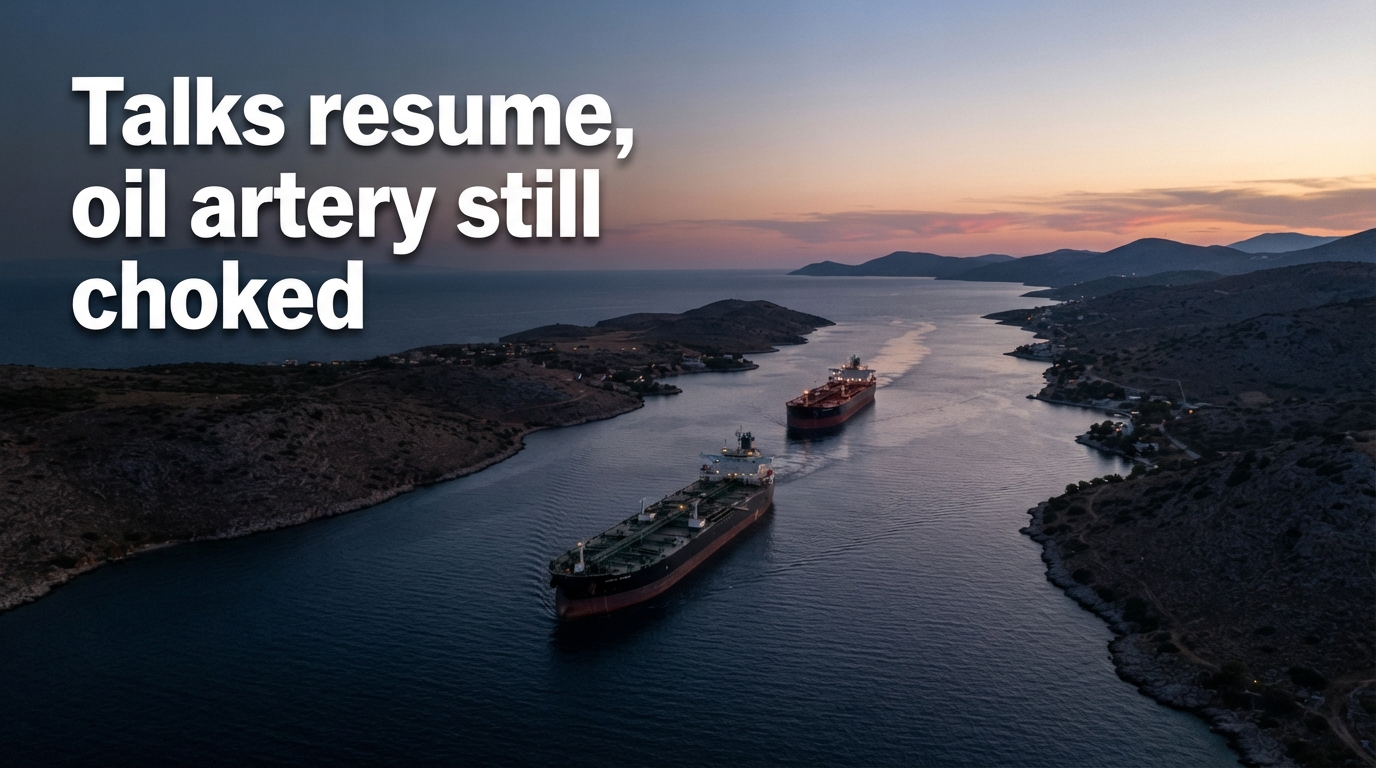
Oil is still near $100 because the world's most important oil waterway is still mostly closed, even as American and Iranian envoys resumed indirect talks in New York.
On Sept. 22-23, the two sides shuttled messages through Qatari mediators to try for a short framework to restart negotiations. There is no meeting planned between U.S. President Donald Trump and Iranian President Masoud Pezeshkian, and the Strait of Hormuz — the narrow passage between Iran and the Arabian Peninsula that carries about a fifth of the world's oil — remains mostly shut.
The Strait of Hormuz and the only ways around it. The Strait of Hormuz is a narrow link between the Persian Gulf and the open ocean, and the map shows the two oil-pipeline corridors that can partially bypass it. The 21 million barrels-per-day figure is the U.S. Energy Information Administration’s 2018 estimate; route and current-status labels use the supplied public reporting. Publisher: U.S. Energy Information Administration — Current pipeline-status — AI-assisted analytic, built only from real cited or sourced data. Source: U.S. Energy Information Administration, gold.cnfol.com (republishing 汇通网 / Huitong), Reuters. As of 2026-09-23.
Why this strait sets the price
Hormuz is the chokepoint that sets the global oil price. In 2018, the last full baseline published by the U.S. Energy Information Administration, the agency that tracks global energy flows, it averaged 21 million barrels a day, about 21% of world petroleum use.
There is almost no way around it. Only Saudi Arabia and the United Arab Emirates have pipelines that bypass Hormuz, with about 3.8 million barrels a day of spare capacity at the end of 2018 — not a substitute for 21 million. Most crude and condensate through Hormuz went to Asian markets. A second chokepoint for Gulf oil toward the Suez Canal, the Bab el-Mandeb Strait off Yemen, carried several million barrels a day in 2018; closing either forces long detours around Africa.
A shuttle, not a summit
The channel is shuttle diplomacy, where mediators carry messages between sides that do not meet face-to-face. Qatar is leading it, with Pakistan named alongside it and Oman as the planned venue.
U.S. envoy Steve Witkoff said in a post on X that the United States and Iran held lengthy talks Sept. 22 via mediators who shuttled between them all day and would continue work. Iranian Foreign Minister Abbas Araqchi met Qatari Prime Minister Sheikh Mohammed bin Abdulrahman Al Thani on the sidelines Sept. 22, according to Qatar's state news agency. Trump said Sept. 22-23 that Witkoff and Jared Kushner — the former Trump adviser acting as envoy — had a "very productive meeting" with mediators and that there is "a lot of momentum" for a deal.
The aim, as Qatari Foreign Ministry spokesman Majed al-Ansari framed it, is a starter framework to restart talks and pave the way for broader regional dialogue, not a final settlement. An interim agreement in June that would have eased financial sanctions and unfrozen Iranian assets in return for talks on limiting Iran's nuclear program unravelled within weeks over the same issue now blocking progress: shipping rules and fees in Hormuz.
Both leaders are in New York for the United Nations General Assembly, the annual gathering of world leaders, but no bilateral is scheduled. Ansari said reopening Hormuz and a viable regional ceasefire are prerequisites for durable dialogue.
A preparatory meeting planned for Sept. 14 in Oman was cancelled after a drone attack forced Saudi Aramco, the Saudi state oil company, to shut its East-West pipeline on Sept. 11. Saudi Arabia blamed an Iraqi militia. The line restarted Sept. 22 at a low rate, with full restart expected in six to eight weeks.
Gulf states say they need a common position before meeting Iran and met on the UNGA margins Sept. 21. Underneath is a trust deficit. Ansari described both sides as expecting the other to blink first, and public positions have hardened. Trump on Sept. 22 framed the choice as deal versus "annihilate the Islamic Republic," while Pezeshkian told the General Assembly Sept. 23 that Iran will not surrender but believes in diplomacy, saying "It cannot be the case that everyone benefits from the Strait of Hormuz while we are denied access." The U.S. delegation walked out at the start of that speech.
No joint communique of the shuttle, Qatari Foreign Ministry statement, transcript of Ansari's remarks, Omani notice about the Sept. 14 meeting, or U.S. State Department or Iranian Foreign Ministry readout has been published, and no Aramco press release confirming the pipeline shutdown has appeared. The account so far rests on the Witkoff post, Trump remarks, an Iranian Foreign Ministry spokesperson and Qatari state media as reported by Reuters. That does not make the shuttle false, but it keeps it one step short of official confirmation.
Brent crude now vs. what EIA expects if Hormuz normalizes. Brent averaged $84 in July and $91 in August; reported spot prices reached $101.5 on Sept. 22 before a $97–100 dip, while EIA’s September outlook holds the second half of 2026 near $90 and puts the 2027 average at $74. The shaded $16 gap is the outlook’s price difference as Middle East flows recover; EIA also estimates global inventories are down 400 million barrels year to date and diesel crack spreads exceed $2 per gallon through November. — AI-assisted analytic, built only from real cited or sourced data. Source: gold.cnfol.com (republishing 汇通网 / Huitong), U.S. Energy Information Administration, Reuters. As of 2026-09-23. Partly unconfirmed: 3 of 12 data points could not be confirmed against a source.
Three demands for one waterway
"Reopening Hormuz" sounds technical. The politics are why flows stay low.
Iran wants reciprocal access and retained control. Tehran says the strait cannot benefit everyone while Iran is denied access under blockade and sanctions. Conditions conveyed via state media for reopening within seven days include immediate lifting of the U.S. naval blockade, immediate release of frozen Iranian assets, and an end to war across all "resistance" fronts. Iran seeks to keep a degree of control over traffic, possibly with Oman and neighbors, to preserve leverage after the June deal collapsed over fees. Foreign Ministry spokesman Esmail Baghaei said Sept. 22 that U.S. blaming of Iran for fuel price hikes tries to evade responsibility for military aggression that disrupted shipping.
The United States, and U.S. Central Command which oversees American forces in the Middle East, wants free passage enforced by pressure. Washington says pre-war freedom of navigation must be restored. Central Command destroyed tankers linked to Iran's Islamic Revolutionary Guard Corps in early September after IRGC ballistic missile attacks on U.S. warships, describing the vessels as a shadow network funding the IRGC and its proxies. The broader posture is described as sanctions, naval blockade and limited airstrikes, not invasion preparation.
Gulf and Qatari mediators want a common security framework. Qatar put on the table at the Trump-Gulf meeting a proposal for a framework involving Iran and Arab Gulf states with guarantees and economic interdependence, which Iran is reviewing. Gulf states are wary of giving Iran too much power over Hormuz while hosting U.S. bases that have come under Iranian attack. Qatar simultaneously condemned Houthi drone and missile attacks on Saudi Arabia, saying Saudi security is integral to Gulf security.
That three-way structure is why a starter framework alone does not equal reopening. Even if mediators find language to restart talks, the contradiction between control as leverage and free passage as principle remains.
What oil is pricing — and what would have to change
Brent crude, the global benchmark, traded around $101 a barrel in Asian trading Sept. 22, near the low end of its range since Sept. 10, then fell toward $97 to $100 on Sept. 22-23 on the pipeline restart and talk hopes. On Sept. 23 it hovered around $100.
The EIA's September outlook, finalized Sept. 3, still has Brent averaging about $90 in the second half of 2026 before falling to $74 in 2027 as inventories rebuild — implying about $16 of elevation from today. The EIA attributes that to two things together: global oil inventories down 400 million barrels so far in 2026, and Middle East export constraints via Hormuz plus limits on alternative routes. It does not break out how much is Iran or Hormuz alone.
What is established downstream is tightness: the EIA expects U.S. diesel and heating oil inventories below the five-year low through much of 2027, with elevated refiner margins if Hormuz traffic normalizes soon — and higher for longer if constraints persist. No decomposition model was provided to support a widely cited $5 to $10 per barrel Iran/Hormuz risk premium, so the Iran-specific share remains unquantified.
Traders are pricing off observed tanker tracking, not official declarations, and official claims diverge. Central Command's top commander in the Middle East, Admiral Brad Cooper, said Sept. 19 that U.S. efforts enabled export of 1 billion barrels through Hormuz over the prior two months — roughly 16 million barrels a day — far above independent analyst estimates and prior U.S. official statements, raising credibility questions. The more consistent description is that traffic remains a fraction of pre-war levels with slow recovery despite U.S. naval efforts amid continued attacks on shipping.
The EIA assumes Middle East production rises gradually on increasing Hormuz flows and bypass pipelines, but constraints persist through end-2026. Normalization by Dec. 31 would need three interlocking triggers, none yet in sight: a ceasefire and security guarantees for shipping, which Ansari calls a prerequisite while attacks continue; a political formula bridging retained control versus free passage; and physical infrastructure security, as the East-West pipeline attack showed how spillover can derail diplomacy and bypass options at once. Markets will not take a communique as proof; sustained tanker data back toward pre-war levels would be needed.
The skeptical case is that the shuttle is positioning, not breakthrough. Witkoff's "lengthy talks" and Trump's "momentum" sit against hardliner backlash: the IRGC-associated Tasnim outlet said Araqchi was wrong to contact Witkoff and Kushner as a "major gift to Trump," Iranian sources said the delegation was ordered not to meet face-to-face by the Supreme National Security Council, and some hardliners viewed the New York trip as an insult to slain Ali Khamenei. Trump himself suggested the situation could end after the Nov. 3 U.S. midterms. Whether Gulf states pursue direct Iran engagement in parallel to the U.S.-led shuttle, or instead of it, is also unresolved.
For now, the hinge holds: talks have resumed, the strait has not.
Source recordSources / claims / limits
How this piece is framed: The chokepoint as hinge: US-Iran shuttle talks have resumed via Qatari mediators at UNGA to unlock the Strait of Hormuz — the world's most important oil artery — but a three-way standoff over who controls the strait keeps flows at a fraction of pre-war levels and oil prices elevated, with normalization requiring more than a handshake.
Charts & tables — AI-assisted; provenance on each line
- Why Hormuz controls a fifth of the world's oil — sourced for this figure · as of 2026-09-23
- Oil is still $90+ because Hormuz is still constrained — sourced for this figure · as of 2026-09-23 · ⚠ Partly unconfirmed: 3 of 12 data points could not be confirmed against a source.
Sources
- (primary) U.S. Destroys 5 IRGC Tankers After Iran Targets Another American Warship — centcom.mil — https://www.centcom.mil/MEDIA/PUBLIC-RELEASES/Article/4593050/us-destroys-5-irgc-tankers-after-iran-targets-another-american-warship/ · read in full · captured 2026-09-23
- (primary) Oman at opening of 81st session of the UN General Assembly — fm.gov.om — https://www.fm.gov.om/en/57169/ · read in full · captured 2026-09-23
- (primary) Media Center Statements index — mofa.gov.qa — https://mofa.gov.qa/en/latest-articles · read in full · captured 2026-09-23
- (primary) Ministry of Foreign Affairs News Archive — Baghaei Sept 22 statement on fuel prices/Hormuz — en.mfa.ir — https://en.mfa.ir/portal/newsarchive/all · read in full · captured 2026-09-23
- (primary) Qatar Strongly Condemns Houthi Attacks on Riyadh — mofa.gov.qa — https://mofa.gov.qa/en/latest-articles/statements/qatar-strongly-condemns-houthi-attacks-on-riyadh · read in full · captured 2026-09-23
- (primary) Qatar Strongly Condemns Houthi Attack on Saudi Arabia's Taif Governorate — mofa.gov.qa — https://mofa.gov.qa/en/latest-articles/statements/qatar-strongly-condemns-houthi-attack-on-saudi-arabia's-taif-governorate · read in full · captured 2026-09-23
- (primary) Emirates today news index — Joint Statement by 8 Foreign Ministers Sept 21 and Trump-Arab/Islamic meeting — mofa.gov.ae — https://www.mofa.gov.ae/en/mediahub/news · read in full · captured 2026-09-23
- (primary) Short-Term Energy Outlook — September 2026 — U.S. Energy Information Administration — https://www.eia.gov/outlooks/steo/ · read in full · captured 2026-09-23
- (primary) Secretary Rubio Travels to the 81st UN General Assembly High-Level Week - 404 archive notice — state.gov — https://www.state.gov/secretary-rubio-travels-to-the-81st-un-general-assembly-high-level-week/ · read in full · captured 2026-09-23
- (primary) News index — fm.gov.om — https://www.fm.gov.om/en/news/news/ · read in full · captured 2026-09-23
- (primary) The Strait of Hormuz is the world's most important oil transit chokepoint — U.S. Energy Information Administration — https://www.eia.gov/todayinenergy/detail.php?id=39932 · read in full · captured 2026-09-23
- (primary) Oman at meeting of President Trump with Arab and Islamic countries — fm.gov.om — https://www.fm.gov.om/en/57196/ · read in full · captured 2026-09-23
- (primary) STEO Petroleum Products — Distillate inventories and crack spreads — U.S. Energy Information Administration — https://www.eia.gov/outlooks/steo/report/petro_prod.php · read in full · captured 2026-09-23
- (primary) Oman's delegation at work at the United Nations General Assembly — fm.gov.om — https://www.fm.gov.om/en/57236/ · read in full · captured 2026-09-23
- (secondary) 联合国大会本周举行,美伊领导人暂无会面安排,油价风险溢价难消退 — gold.cnfol.com (republishing 汇通网 / Huitong) — http://gold.cnfol.com/guojiyuanyousc/20260922/32377525.shtml · read in full · captured 2026-09-23
- (secondary) Will the U.S. invade Iran before 2027? — Market Context — Polymarket — https://polymarket.com/event/will-the-us-invade-iran-before-2027 · read in full · captured 2026-09-23
- (secondary) Tehran hints Hormuz talks with US leaders gather at UN — Reuters — https://www.reuters.com/world/middle-east/tehran-hints-hormuz-talks-with-us-leaders-gather-un-2026-09-22/ · read in full · captured 2026-09-23
- (secondary) Saudi Arabia restarts East-West oil pipeline, to resume exports at Yanbu, sources say — Reuters — https://www.reuters.com/business/energy/saudi-arabia-restarts-east-west-oil-pipeline-resume-exports-yanbu-sources-say-2026-09-22/ · read in full · captured 2026-09-23
- (secondary) Gulf bourses edge higher as Saudi pipeline resumes operations — Reuters — https://www.reuters.com/world/middle-east/gulf-bourses-edge-higher-saudi-pipeline-resumes-operations-2026-09-23/ · read in full · captured 2026-09-23
- (secondary) Iran submits conditions for reopening of Hormuz to U.S. representative, state media says — Reuters — https://www.reuters.com/world/middle-east/iran-submits-conditions-reopening-hormuz-us-representative-state-media-says-2026-09-22/ · read in full · captured 2026-09-23
- (secondary) Iran's president says Tehran will not surrender, war with US but believes in diplomacy — Reuters — https://www.reuters.com/world/middle-east/irans-president-says-tehran-will-not-surrender-war-with-us-but-believes-2026-09-23/ · read in full · captured 2026-09-23
- (secondary) Hope for progress after US, Iran hold first shuttle talks in months — Reuters — https://www.reuters.com/world/middle-east/hope-progress-after-us-iran-hold-first-shuttle-talks-months-2026-09-23/ · read in full · captured 2026-09-23
- (secondary) Oil falls on increased Gulf supply, hopes for US-Iran talks — Reuters — https://www.reuters.com/business/energy/oil-falls-increased-gulf-supply-hopes-us-iran-talks-2026-09-23/ · read in full · captured 2026-09-23
Claims, and how far we tracked each down
- [confirmed] The Strait of Hormuz is the world's most important oil chokepoint, averaging 21 million b/d in 2018 — about 21% of global petroleum liquids consumption, one-third of seaborne oil trade, and over one-quarter of LNG trade · read in full (as of 2026-09-23)
- [likely] A June memorandum of understanding between the U.S. and Iran collapsed before the current shuttle talks · read in full (as of 2026-09-23)
- [confirmed] EIA assumes Middle East oil production will rise gradually on increasing Hormuz flows and alternative routes, but constraints persist through end-2026 keeping production below pre-conflict averages until Q2 2027 · read in full (as of 2026-09-23)
- [confirmed] No Aramco official statement on East-West pipeline shutdown was found on aramco.com news (674 results, latest Aug 24) — pipeline status relies on Reuters sourcing from three briefed sources and satellite imagery, not Aramco press release · read in full (as of 2026-09-23)
- [confirmed] U.S. Special Envoy Steve Witkoff posted on X that U.S. and Iran engaged in lengthy talks Sept 22 via mediators who shuttled between sides throughout the day and that mediators would continue work · read in full (as of 2026-09-23)
- [confirmed] Iran seeks to retain a degree of control over Strait of Hormuz traffic, possibly in cooperation with Oman and other neighbors, to preserve strategic leverage · read in full (as of 2026-09-23)
- [confirmed] Iranian President Pezeshkian told UNGA Sept 23 Iran will not surrender but believes in diplomacy, said 'It cannot be the case that everyone benefits from the Strait of Hormuz while we are denied access,' and U.S. delegation walked out at start of speech · read in full (as of 2026-09-23)
- [confirmed] A planned meeting on Sept 14 in Oman between Gulf state diplomats plus Iraq and an Iranian delegation to discuss regional issues including Hormuz shipping was cancelled at the last minute · read in full (as of 2026-09-23)
- [confirmed] EIA forecasts U.S. distillate inventories below 100 million barrels in September and below the 5-year low through much of 2027, with diesel crack spreads above $2 per gallon Aug-Nov assuming Hormuz traffic normalizes near-term; if constraints persist beyond end-2026 spreads would be higher · read in full (as of 2026-09-23)
- [confirmed] U.S. and Iranian officials held first known indirect shuttle talks in months on Sept 22-23, 2026 on UNGA sidelines via mediators, with U.S. envoys Steve Witkoff and Jared Kushner and Iranian Foreign Minister Abbas Araqchi communicating through mediators · read in full (as of 2026-09-23)
- [confirmed] US Secretary of State Marco Rubio said Sept 22 US will always support Saudi Arabia but called Houthi conflict 'very dangerous and complex' that 'pre-exists' and said US doesn't want its history with Houthis impacted — signaling US reluctance to rejoin anti-Houthi fight · read in full (as of 2026-09-23)
- [confirmed] Iran engaged through a Qatari mediator and conveyed conditions including end to war on all fronts and halt to U.S. 'acts of aggression' / lifting naval blockade and release of frozen assets · read in full (as of 2026-09-23)
- [confirmed] Saudi Arabia's East-West Pipeline (capacity 7m b/d) was shut Sept 11 after drone attacks Saudi Arabia blamed on Iraqi militia, damaging three pumping stations; it restarted Sept 22 at low rate pumping ~4m b/d rerouted volume, with full restart expected 6-8 weeks, and Yanbu exports to resume · read in full (as of 2026-09-23)
- [confirmed] Strait of Hormuz traffic remains only a fraction of pre-war levels with slow recovery despite U.S. naval efforts to enable tanker passage amid continued Iranian attacks on shipping · read in full (as of 2026-09-23)
- [confirmed] Iranian President Masoud Pezeshkian and U.S. President Donald Trump both attended UNGA in New York the week of Sept 22, 2026, with no leader meeting scheduled · read in full (as of 2026-09-23)
- [likely] U.S. and Iranian officials held shuttle talks via Qatari mediators at the UN General Assembly in New York on September 22-23, 2026 · read in full (as of 2026-09-23)
- [confirmed] Iranian MFA spokesman Esmail Baghaei said Sept 22 US blaming Iran for fuel price hikes is attempt to evade responsibility for consequences of its military aggression that disrupted commercial shipping and closed Strait of Hormuz · read in full (as of 2026-09-23)
- [confirmed] In 2018, 76% of crude and condensate through Hormuz went to Asian markets (China, India, Japan, South Korea, Singapore accounting for 65% of flows); the U.S. imported 1.4 million b/d via Hormuz (18% of imports, 7% of consumption) · read in full (as of 2026-09-23)
- [likely] Analyst dissent that Gulf direct channel undercuts US: Ratney view (Gulf abandoning hope in US diplomacy, pivoting to direct Iran engagement) is contested by evidence of continued Gulf participation in US-led meetings (Sept 21 joint statement, Sept 23 Trump-Arab meeting) and Qatar's simultaneous mediation and solidarity with Saudi — suggesting parallel tracks rather than bypass · read in full (as of 2026-09-23)
- [confirmed] Dissent that shuttle is performative/stalling: Tasnim (IRGC-associated) said Araqchi was wrong to contact Witkoff/Kushner as 'major gift to Trump'; Iranian sources told Reuters delegation ordered not to meet face-to-face by Supreme National Security Council including figures selected by Ayatollah Mojtaba Khamenei; some hardliners viewed New York trip as insult to slain Ali Khamenei · read in full (as of 2026-09-23)
- [confirmed] Iranian official position on Hormuz as conveyed via state media and UNGA: conditions to reopen Strait within 7 days include immediate lifting of US naval blockade, immediate release of frozen Iranian assets, and end of war across all 'resistance' fronts; President Pezeshkian told UNGA Sept 23 'It cannot be the case that everyone benefits from the Strait of Hormuz while we are denied access' — framing control as reciprocal access · read in full (as of 2026-09-23)
- [confirmed] Global oil inventories have fallen by 400 million barrels so far in 2026, supporting elevated prices · read in full (as of 2026-09-23)
- [confirmed] US official position beyond 'free navigation' rhetoric is active naval enforcement: CENTCOM destroyed 5 IRGC crude carriers Sept 8 (and 3 on Sept 5) after IRGC ballistic missile attacks on US warships, describing tankers as multibillion-dollar shadow network funding IRGC/proxies; Trump Sept 22 framed choice as 'annihilate the Islamic Republic' vs deal, while US delegation walked out at start of Pezeshkian UNGA speech · read in full (as of 2026-09-23)
- [confirmed] No primary Qatari MOFA readout of shuttle talks, no Majed al-Ansari Concordia Summit transcript/video, no Omani MFA Sept 14 meeting notice/cancellation, and no U.S. State Dept or Iranian MFA readout of shuttle talks were recovered in deep reads of mofa.gov.qa statements/news and fm.gov.om news/statements and state.gov on Sept 23 · read in full (as of 2026-09-23)
- [confirmed] Brent averaged $91 per barrel in August 2026, $7 higher than July, and EIA forecasts Brent to average around $90 in 2H26 before falling to $74 in 2027 as inventories rebuild · read in full (as of 2026-09-23)
- [confirmed] Qatar and Pakistan have taken a leading mediation role, with Oman as the planned venue for regional diplomacy · read in full (as of 2026-09-23)
- [confirmed] An interim agreement reached in June 2026, signed by Trump and Pezeshkian, would have given Iran lifting of financial sanctions and unfreezing of assets in return for talks on limiting its nuclear programme, but unravelled within weeks over shipping rules in the Strait of Hormuz where Iran wants to exert control and collect fees · read in full (as of 2026-09-23)
- [likely] The U.S. maintains sanctions, a naval blockade, and limited airstrikes targeting Iranian military and shipping threats · read in full (as of 2026-09-23)
- [confirmed] Brent crude traded around $101.30-$101.52 per barrel in Asian trading on Sept 22, 2026, near the low end of its range since Sept 10 · read in full (as of 2026-09-23)
- [confirmed] Iranian Foreign Minister Abbas Araqchi met Qatari Prime Minister Sheikh Mohammed bin Abdulrahman Al Thani on UNGA sidelines Sept 22, per Qatari state news agency as reported by Reuters · read in full (as of 2026-09-23)
- [confirmed] Trust-deficit quote ('both sides expect the other to blink first' — Ansari) is Qatari mediator characterization, not mutual admission; counter-view: both sides publicly hardened positions at UNGA (Trump 'annihilate' vs Pezeshkian 'will never surrender') while privately shuttling, indicating distrust is structural and mediator framing may understate coercive leverage · read in full (as of 2026-09-23)
- [confirmed] The 1 billion barrel / ~16 million b/d figure is far above independent analyst estimates and above prior statements by other U.S. officials, raising credibility questions · read in full (as of 2026-09-23)
- [confirmed] The talks aim for a short-term agreement to restart negotiations and pave way for broader regional dialogue, not a final agreement · read in full (as of 2026-09-23)
- [confirmed] President Trump said Sept 22-23 that Witkoff and Kushner had a 'very productive meeting' with mediators of Iran and that there is 'a lot of momentum for them to make a deal' · read in full (as of 2026-09-23)
- [confirmed] Gulf common-position effort documented: 8 foreign ministers (UAE, Saudi Arabia, Qatar, Jordan, Indonesia, Pakistan, Türkiye, Egypt) met Sept 21 on UNGA margins (UAE MOFA joint statement); Oman participated in Trump meeting with Arab/Islamic leaders Sept 23 reaffirming dialogue/constructive neutrality; Qatar Sept 20 condemned Houthi attacks on Riyadh/Taif as violation of Saudi sovereignty and said Saudi security is integral to Qatar/GCC security · read in full (as of 2026-09-23)
- [confirmed] Former U.S. ambassador to Saudi Arabia Michael Ratney said Gulf states may be abandoning hope that U.S. diplomacy can end the war and pivoting to direct engagement with Iran, and that any Houthi de-escalation would likely start with Iran · read in full (as of 2026-09-23)
- [confirmed] Qatar's Ministry of Foreign Affairs issued primary statements Sept 17 and Sept 20, 2026 strongly condemning Houthi drone/ballistic missile attacks on Saudi Arabia (Taif governorate civilian casualties; Riyadh, Bish, Farasan, Yanbu) · read in full (as of 2026-09-23)
- [confirmed] Only Saudi Arabia and the UAE have pipelines that can bypass Hormuz, with combined available capacity of 6.5 million b/d at end-2018, of which 2.7 million b/d was used leaving 3.8 million b/d unused · read in full (as of 2026-09-23)
- [confirmed] U.S. Central Command's top commander Admiral Brad Cooper said on Sept 19, 2026 that U.S. efforts enabled export of 1 billion barrels of crude and products through Hormuz over the prior two months · read in full (as of 2026-09-23)
- [confirmed] Qatari spokesman Majed al-Ansari said both sides expect the other to blink first, reflecting mutual distrust and reluctance to make first concessions · read in full (as of 2026-09-23)
- [confirmed] Competing Gulf framing: Reuters Sept 22 reports Qatari proposal for common security framework involving Iran and Arab Gulf states was on table at Trump-Gulf meeting, with Iran reviewing proposal; Gulf states described as wary of giving Iran too much power over Hormuz and hosting US bases under Iranian attack · read in full (as of 2026-09-23)
- [confirmed] The cancellation was attributed to a drone attack that forced Saudi Aramco to shut its 7 million b/d East-West pipeline · read in full (as of 2026-09-23)
- [unconfirmed] Oil markets retain a $5-10 per barrel risk premium attributable to Iran-related Strait of Hormuz disruption risk · our synthesis across the evidence — no single cited source
- [confirmed] Oman participated in 81st UNGA opening Sept 22 and in multilateral meeting hosted by President Trump with Arab/Islamic leaders Sept 23, reaffirming dialogue and diplomacy · read in full (as of 2026-09-23)
- [confirmed] Brent crude fell toward $97-100 on Sept 22-23 on pipeline restart and US-Iran talk hopes, hitting lowest since Sept 8, after earlier surge on Houthi offensive threatening Red Sea traffic · read in full (as of 2026-09-23)
Where we hit a limit / what to double-check
- "Oil markets retain a $5-10 per barrel risk premium attributable to Iran-related Strait of Hormuz disruption risk" is our reading across the evidence, not a single sourced fact.