
Satyress’s centaur robot Threehalves has detailed rescue design claims, but no validated disaster-zone performance
Satyress, a California robotics startup, says its teleoperation-based “superhumanoid” robot can be modularly repaired and has fail-safety features, but the available record does not show it operating successfully in disaster zones.

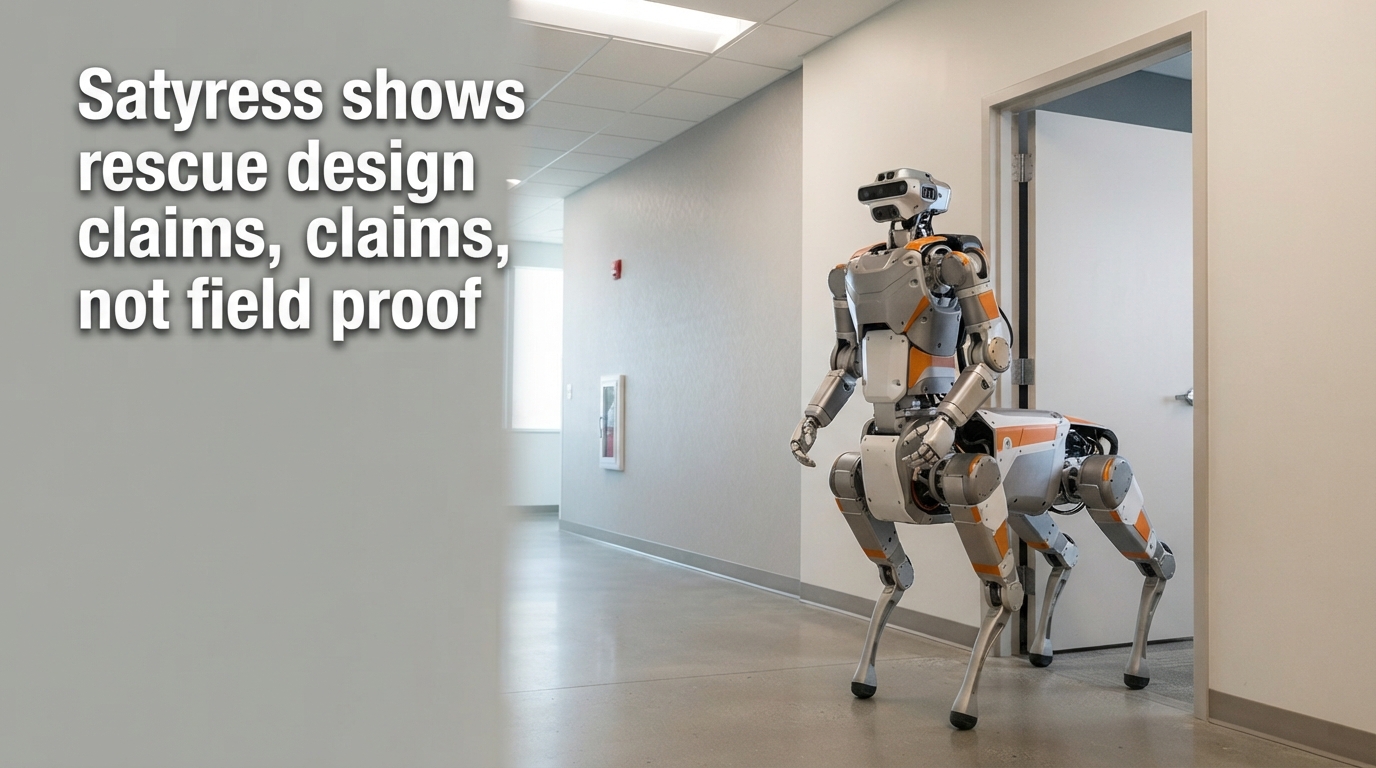
Satyress is a California robotics startup with an official website, and the site says its robot is called Threehalves.
The company describes Threehalves as a “superhumanoid general purpose robot” with a centaur chassis. It also says the machine is meant for dangerous work in extreme environments and relies on teleoperation rather than full autonomy. That puts it in the orbit of rescue robotics: machines built for places people cannot safely enter, including disaster zones. But that is still an intended-use claim, not proof that the robot has done the job.
The site goes further than a generic teaser. It says the robot’s limbs, torso, and head can be replaced and recalibrated in minutes if damaged, using common fasteners. It says Threehalves includes fail-on air brakes and pin locks, and that shared pressure reservoirs can be pierced to stop it in place. It also gives blunt limits: the robot will be substantially slowed at a standard 32-by-80-inch door and cannot turn around in a 42-inch hallway.
Secondary coverage repeats some of the same specifics, including a two-meter height claim, remote joystick control, and modular tools such as a chainsaw, drill, or screwdriver. One report also said the price and release date were not yet known. Brett Winton’s X post, by contrast, is not a technical source: when deep-read, it only says he likes that people are thinking outside the box in terms of form factor, but he has trouble conceptualizing the strategic logic behind this particular design choice.
The evidentiary gap is still the point. The recovered sources support a real company, a named product, and a detailed design story. They do not establish field deployment, validated disaster-zone performance, autonomy behavior, payload, or readiness. So the strongest defensible reading is not that Satyress has shown a rescue robot working in the wild, but that it has made a specific claim about one.
A broader robotics reading is possible, but only conditionally. If centaur-shaped machines prove useful in hard environments, they would fit a wider trend toward specialized rescue hardware. This record does not show that Satyress is already an important case in that trend.
Source recordSources / claims / limits
How this piece is framed: The story is an evidentiary-status story about a startup’s centaur-shaped robot announcement, but with a two-tier structure: the record does establish a set of concrete first-party design claims about Threehalves — company identity, product name, centaur chassis, teleoperation-focused use, replaceable parts, safety mechanisms, doorway constraints, and secondary repeats of height/control/tooling — while still failing to establish validated operational performance in disaster zones.
Sources
- (primary) Satyress - Robots That Work — https://www.satyress.com/ · read in full · captured 2026-07-30
- (secondary) Это не шутка: представлен двухметровый робот-кентавр Threehalves для работы в экстремальных условиях — Gagadget — https://gagadget.com/ru/720205-eto-ne-shutka-predstavlen-dvuhmetrovyij-robot-kentavr-threehalves-dlya-raboti-v-ekstremalnyih-usloviyah/ · read in full · captured 2026-07-30
- (primary) X — Same Brett Winton post URL variant — https://x.com/wintonARK/status/2082737122964885963 · full text not obtained — used its summary
- (primary) X — Brett Winton post about Satyress centaur robot — https://x.com/i/web/status/2082737122964885963 · full text not obtained — used its summary
Claims, and how far we tracked each down
- [confirmed] The official Satyress site exists and explicitly identifies the company as “Satyress Robotics - Auburn, California,” with contact info at info@satyress.com. · read in full (as of 2026-07-30)
- [confirmed] Satyress has an official company website that identifies the company as “Satyress Robotics - Auburn, California” and provides contact info at info@satyress.com, with a link to @satyressrobots. · read in full (as of 2026-07-30)
- [confirmed] The official Satyress website presents the robot product as “Threehalves,” a “superhumanoid general purpose robot,” and explicitly describes a centaur chassis. · read in full (as of 2026-07-30)
- [confirmed] Satyress says Threehalves uses a teleoperation-focused approach and is aimed at jobs dangerous to humans because of injury/death risk or extreme environmental conditions. · read in full (as of 2026-07-30)
- [confirmed] The official site states that limbs, torso, and head can be replaced and recalibrated in minutes if damaged. · read in full (as of 2026-07-30)
- [confirmed] The official site states that Threehalves will be substantially slowed at a standard American 32"x80" door and cannot turn around in a 42" hallway. · read in full (as of 2026-07-30)
- [confirmed] The official Satyress site states that Threehalves is more dangerous than it looks and includes physical safety mechanisms such as fail-on air brakes, pin locks, and pressure reservoirs that can be pierced to stop the robot. · read in full (as of 2026-07-30)
- [confirmed] The official Satyress site says Threehalves will be substantially slowed in a standard 32"x80" door and cannot turn around in a 42" hallway. · read in full (as of 2026-07-30)
- [confirmed] The available sources do not validate real-world disaster-zone performance, deployment, payload, autonomy, or readiness for operation. · read in full (as of 2026-07-30)
- [confirmed] Gagadget reports that Threehalves is controlled remotely with a joystick and can be fitted with modular tools such as a chainsaw, drill, or screwdriver. · read in full (as of 2026-07-30)
- [confirmed] Gagadget reports that the price and release date of Threehalves were not yet known at publication time. · read in full (as of 2026-07-30)
- [confirmed] Brett Winton posted on X that California startup Satyress unveiled a two-meter-tall centaur robot designed to enter disaster zones too dangerous for humans. · read in full (as of 2026-07-30)
- [confirmed] This research pass did not recover a readable primary company announcement or independent technical coverage beyond the X post. · from a source summary — we did not read the full source
- [speculative] A centaur form factor could offer practical advantages in rescue environments, but that remains speculative here. · our synthesis across the evidence — no single cited source
Where we hit a limit / what to double-check
- We did not obtain the full text of Same Brett Winton post URL variant (https://x.com/wintonARK/status/2082737122964885963); claims resting on it are from its summary — you may be able to reach it directly.
- We did not obtain the full text of Brett Winton post about Satyress centaur robot (https://x.com/i/web/status/2082737122964885963); claims resting on it are from its summary — you may be able to reach it directly.
- "A centaur form factor could offer practical advantages in rescue environments, but that remains speculative here." is our reading across the evidence, not a single sourced fact.