
NASA pays to rescue Swift, suspending its pointed science as orbit decays
NASA says the aging Swift Observatory has no propulsion and is losing altitude from drag, so it is temporarily halting UVOT and XRT observations while it tries a Link servicer rescue this summer.


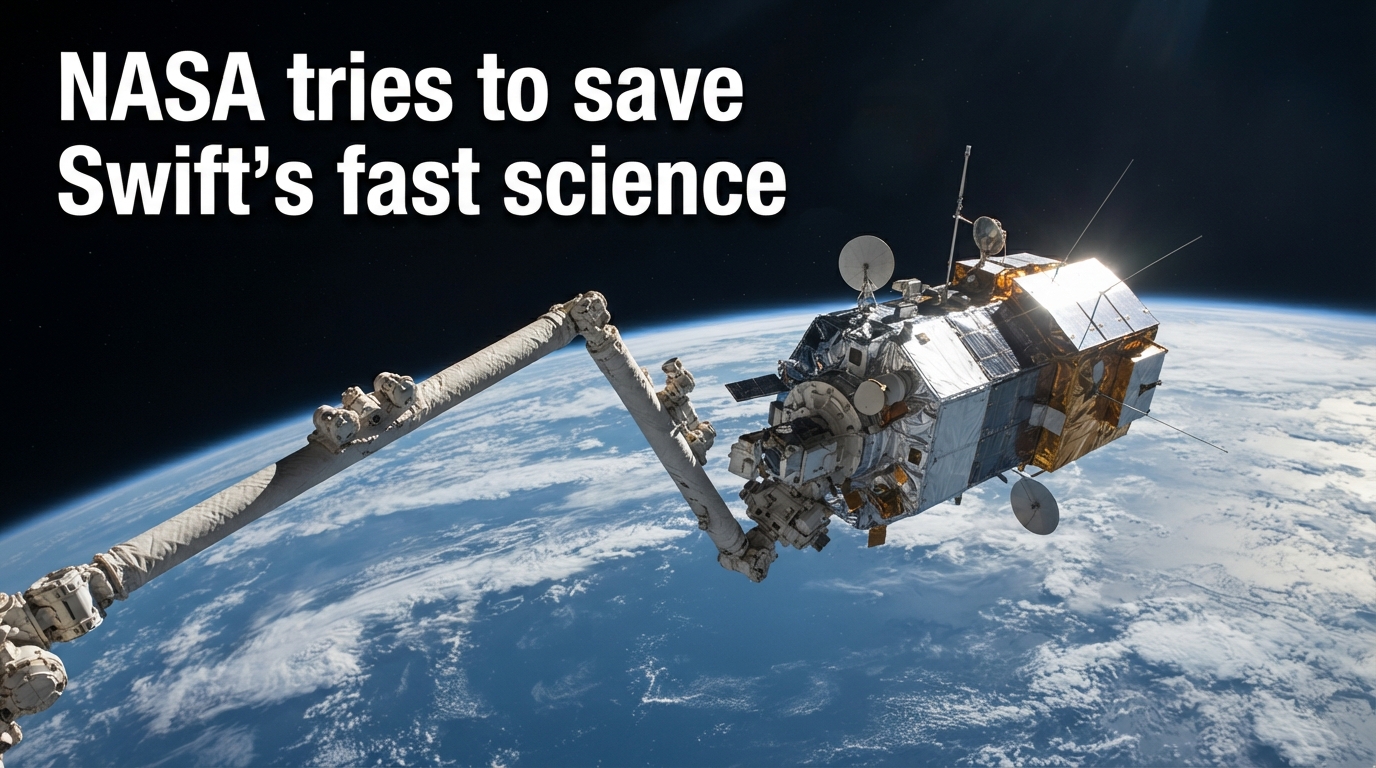
NASA’s Neil Swift Observatory is an old but still unusually fast transient mission: it was built to detect gamma-ray bursts, relay their positions quickly, and then repoint across gamma-ray, X-ray, ultraviolet and optical wavelengths before the afterglow fades. Swift is now in trouble because it has no propulsion of its own, atmospheric drag is steadily lowering its orbit, and NASA says pointed science with its UVOT and XRT instruments is temporarily suspended while the spacecraft awaits an orbit boost planned for this summer.
NASA faces a simple choice: try to keep Swift alive with a rescue maneuver, or let a still-useful observatory drift until it reenters and burns up. Because Swift cannot raise its own orbit, the question is how long it can keep operating before drag lowers it too far for safe, stable work. That is why NASA is paying Katalyst Space Technologies about $30 million to try to save the satellite with Link, a commercial servicer that launched in July.
The rescue craft has had its own attitude-control problems: NASA says two of Link’s three reaction wheels are not operable and that some functionality in its cold-gas thruster system has been lost. Reaction wheels are standard hardware used to point and stabilize a spacecraft, so that failure does not end the mission by itself — but it makes the rendezvous and stabilization work harder.
The reason NASA is trying at all is that Swift still does science that is hard to replace. Its UVOT can observe ultraviolet and optical wavelengths blocked from the ground, and its X-ray telescope adds another fast follow-up channel for fleeting events. The recent black-hole result shows that value in practice. Swift helped confirm a tidal disruption event, a flare produced when a black hole tears a star apart, in the outskirts of a galaxy more than 30,000 light-years from the center.
The chain of evidence ran from Zwicky Transient Facility, which first flagged the flare in November 2025, to SOAR spectroscopy in Chile and then to Swift’s UVOT temperature measurements. NASA says that combination helped rule out other explanations and support the tidal-disruption interpretation. The flare briefly shone with the light of about 10 billion suns in ultraviolet wavelengths, and Swift’s UVOT measured a temperature of about 54,000 degrees Fahrenheit.
What the finding does not do is settle the whole question of wandering black holes. The paper on the event, led by Robert Stein and published in The Astrophysical Journal Letters, describes the source as an apparent orphan black hole and says the black hole was either flung outward in a merger or sits in a faint dwarf galaxy still merging with a larger one. NASA says the result validates a search strategy for finding supermassive black holes away from galactic cores, but it is still a case study, not a census. If Link can restore Swift’s orbit in time, UVOT and XRT can keep doing that kind of rapid follow-up; if it cannot, the scientific question stays open but the observatory’s role in answering it ends.
That is also why Swift remains worth the trouble. The black-hole flare shows what the observatory can still add: rapid ultraviolet and X-ray follow-up on transients that ground facilities cannot fully measure. If the rescue works, Swift can keep doing that. If it fails, NASA loses one of the few active observatories tuned for exactly this kind of fast-changing sky.
Swift rescue timeline and operational knock-on
Timeline of the Swift rescue effort: key events and when Swift’s science was paused awaiting an orbit-boost attempt This timeline shows Swift’s 2004 launch, the July 2026 Link launch, the pause in pointed science, and the planned orbit-boost rescue against the risk of reentry. The key operational change is that science is suspended while the mission awaits a summer boost; the summer and next-few-months windows are approximate because the supplied sources do not give exact dates. — AI-assisted analytic, built only from real cited or sourced data. Source: NASA Swift mission page, NASA HEASARC, Ars Technica. As of 2026-07-29.
Source recordSources / claims / limits
How this piece is framed: Center the story as NASA’s decision under time pressure to preserve Swift’s uniquely fast multiwavelength transient capability: the spacecraft’s pointed science is already suspended while it awaits an orbit-boost rescue, and a recent off-center tidal-disruption event shows what would be lost if that capability disappears. The load-bearing question is not just whether a rescue vehicle works, but whether NASA can keep an aging, propulsion-less observatory alive long enough to keep doing science no ground telescope can do.
Charts & tables — each built only from the cited claims below, by an AI tool
- Swift rescue timeline and operational knock-on — from claims clm_992b3745d1, clm_5438ff84d7, clm_34bfeb821a, clm_f91600c230, clm_157d9b237c, clm_fbd174ebb5 · as of 2026-07-29
- How far the “wandering black hole” flare was from its galaxy center — from claims clm_b03526a906, clm_568a5a13e4, clm_078e928b13 · as of 2026-07-29
Sources
- (primary) About the Swift Gamma-Ray Burst Mission — NASA Swift mission page — https://swift.gsfc.nasa.gov/about_swift/ · read in full · captured 2026-07-29
- (primary) Neil Gehrels Swift Observatory — NASA — https://www.nasa.gov/mission/neil-gehrels-swift-observatory/ · read in full · captured 2026-07-29
- (primary) NASA’s Swift Sees ‘Wandering’ Mega Black Hole Shredding Star — NASA Science — https://science.nasa.gov/missions/swift/nasas-swift-sees-wandering-mega-black-hole-shredding-star/ · read in full · captured 2026-07-29
- (primary) About the Swift Gamma-Ray Burst Mission — NASA HEASARC — https://heasarc.gsfc.nasa.gov/docs/swift/about_swift/ · read in full · captured 2026-07-29
- (secondary) Blazing like 10 billion suns: NASA’s Swift sees a wandering black hole devouring a star — ScienceDaily / NASA’s Goddard Space Flight Center material — https://www.sciencedaily.com/releases/2026/07/260727214609.htm · read in full · captured 2026-07-29
- (secondary) Reaction wheel failures leave Swift rescue mission spinning in orbit — Ars Technica — https://arstechnica.com/space/2026/07/reaction-wheel-failures-leave-swift-rescue-mission-spinning-in-orbit/ · read in full · captured 2026-07-29
Claims, and how far we tracked each down
- [confirmed] Swift’s pointed science observations were temporarily suspended while the mission awaited an orbit boost planned for this summer. · read in full (as of 2026-07-29)
- [confirmed] The rescue satellite Link experienced attitude-control problems, including two of its three reaction wheels becoming inoperable and some loss of functionality in its cold-gas thruster system. · read in full (as of 2026-07-29)
- [confirmed] Swift’s UVOT helped confirm a tidal disruption event in which a supermassive black hole tore apart a star in the outskirts of a distant galaxy. · read in full (as of 2026-07-29)
- [confirmed] Swift is slowly sinking toward Earth due to atmospheric drag, and nudging it to a higher orbit could extend its lifetime. · read in full (as of 2026-07-29)
- [confirmed] NASA’s Neil Gehrels Swift Observatory is a multiwavelength observatory dedicated to gamma-ray burst science. · read in full (as of 2026-07-29)
- [confirmed] Swift’s three instruments cover gamma-ray, X-ray, ultraviolet, and optical wavebands and are designed to rapidly repoint to capture burst afterglows. · read in full (as of 2026-07-29)
- [confirmed] Swift relays burst positions to the ground within about 20 seconds of initial detection and can autonomously repoint within about 90 seconds. · read in full (as of 2026-07-29)
- [confirmed] The Swift spacecraft has no propulsion system of its own. · read in full (as of 2026-07-29)
- [likely] Atmospheric drag is gradually pulling Swift to a lower orbit, and without a rescue it is on track to reenter and burn up within the next few months. · read in full (as of 2026-07-29)
- [confirmed] NASA is paying Katalyst Space Technologies about $30 million for the rescue service. · read in full (as of 2026-07-29)
- [confirmed] Reaction wheels are standard spacecraft components used to control attitude by exchanging momentum. · read in full (as of 2026-07-29)
- [confirmed] Link launched on July 3, 2026 aboard a Northrop Grumman Pegasus XL rocket. · read in full (as of 2026-07-29)
- [likely] Link’s electric thrusters are intended for orbit raising and are being used in part to stabilize the spacecraft during the rescue attempt. · read in full (as of 2026-07-29)
- [confirmed] The transient was first flagged in November 2025 by Zwicky Transient Facility and is about 750 million light-years away. · read in full (as of 2026-07-29)
- [confirmed] Swift’s UVOT measured the flare’s temperature at about 54,000 degrees Fahrenheit (30,000 degrees Celsius). · read in full (as of 2026-07-29)
- [confirmed] NASA says the event was more than 30,000 light-years from the galaxy’s center. · read in full (as of 2026-07-29)
- [confirmed] NASA’s Swift article says the off-center flare was interpreted as a tidal disruption event, but the authors explicitly framed it as an “apparent ‘orphan’ black hole” and said the combination of ZTF, SOAR, and Swift data “helped rule out other explanations.” · read in full (as of 2026-07-29)
- [confirmed] The NASA article identifies at least two alternative origin scenarios for the off-center source: a black hole ejected during a multi-galaxy merger, or a dwarf galaxy still in the process of merging with the larger host. · read in full (as of 2026-07-29)
- [confirmed] NASA says the result validated a new technique for finding supermassive black holes wandering away from galactic cores, and the researchers outlined alternative origin scenarios. · read in full (as of 2026-07-29)
- [confirmed] The same NASA summary notes that prior TDE searches were concentrated in galaxy cores and that the newly identified off-center event is one more data point toward a future census, not a population measurement. · read in full (as of 2026-07-29)
- [confirmed] The NASA summary names the discriminants used against alternative explanations as the event spectrum from SOAR and the UV temperature from Swift/UVOT, which together strengthened the TDE classification despite the unusual location. · read in full (as of 2026-07-29)
- [likely] The transient was first noticed by Zwicky Transient Facility data in November 2025. · read in full (as of 2026-07-29)
- [likely] The discovery supports a search strategy for wandering supermassive black holes away from galactic centers. · read in full (as of 2026-07-29)
- [likely] Swift’s pointed science observations were temporarily suspended while the mission awaited an orbit boost planned for the summer. · read in full (as of 2026-07-29)
- [confirmed] Swift was launched into low-Earth orbit on November 20, 2004. · read in full (as of 2026-07-29)
- [confirmed] Swift discovers approximately 100 gamma-ray bursts per year. · read in full (as of 2026-07-29)
- [confirmed] The event occurred more than 30,000 light-years from the galaxy’s center. · read in full (as of 2026-07-29)
- [likely] The flare briefly outshone the entire host galaxy in ultraviolet light and reached a luminosity described as about 10 billion suns. · read in full (as of 2026-07-29)
- [likely] The black hole’s mass is roughly one million times the Sun’s mass. · read in full (as of 2026-07-29)