
Article
Maldives bets half a new artificial island on a $12bn-$20bn waterfront and marina
A terms sheet, not a final deal, promises a waterfront up to nearly three times GDP funded largely by future buyers via escrow in local banks, with the split between firm equity and contingent sales due when the definitive agreement lands by end-October.


Published before our editing checks were satisfied: some claims here may be stated more firmly than the evidence supports.
Pictures in this frame are AI-generated, not photographs.
What happenedAbu Dhabi developer Eagle Hills signed commercial terms for 500 hectares at the new Ras Malé reclaimed city, described as a $12bn waterfront by the builder and $20bn by the government, with a definitive agreement due by end-October.
Why it mattersAt up to nearly three times the $7.5bn economy, the buyer-funded project could deliver 65,000 homes without sovereign borrowing — or strain banks, foreign-currency reserves and reefs if demand falls short.
Still openHow much is firm Eagle Hills equity versus debt and off-plan sales that must still find foreign buyers, and whether escrow flows and reef protections hold under thin reserves and oversight.
On 21 September in Dubai, the Maldives signed commercial terms handing about half its newest artificial city to Abu Dhabi developer Eagle Hills. The parcel is 500 hectares at Ras Malé — a 1,150-hectare platform being dredged at Fushi Dhiggaru Lagoon, about 17 minutes by speedboat from Malé, the capital of an Indian Ocean archipelago of about 1,200 islands and 520,000 people.
How a single waterfront compares to the whole Maldivian economy. This compares Maldives’ 2025 projected nominal GDP with the reported scale of the Eagle Hills waterfront, the MIFC pledge, tourism receipts and 2026 external debt service, in current US dollars. The $12bn developer figure is about 1.6 times GDP, while the $20bn government figure is about 2.7 times and the preliminary $30bn gross lifetime estimate is about four times. GDP uses the IMF WEO April 2025 projection, so revisions can change the multiples; the $30bn estimate includes buyer capital and resales rather than committed developer capex. — AI-assisted analytic, built only from real cited or sourced data. Source: IMF DataMapper / WEO Database April 2025, IMF, World Bank WDI. As of 2026-09-22.
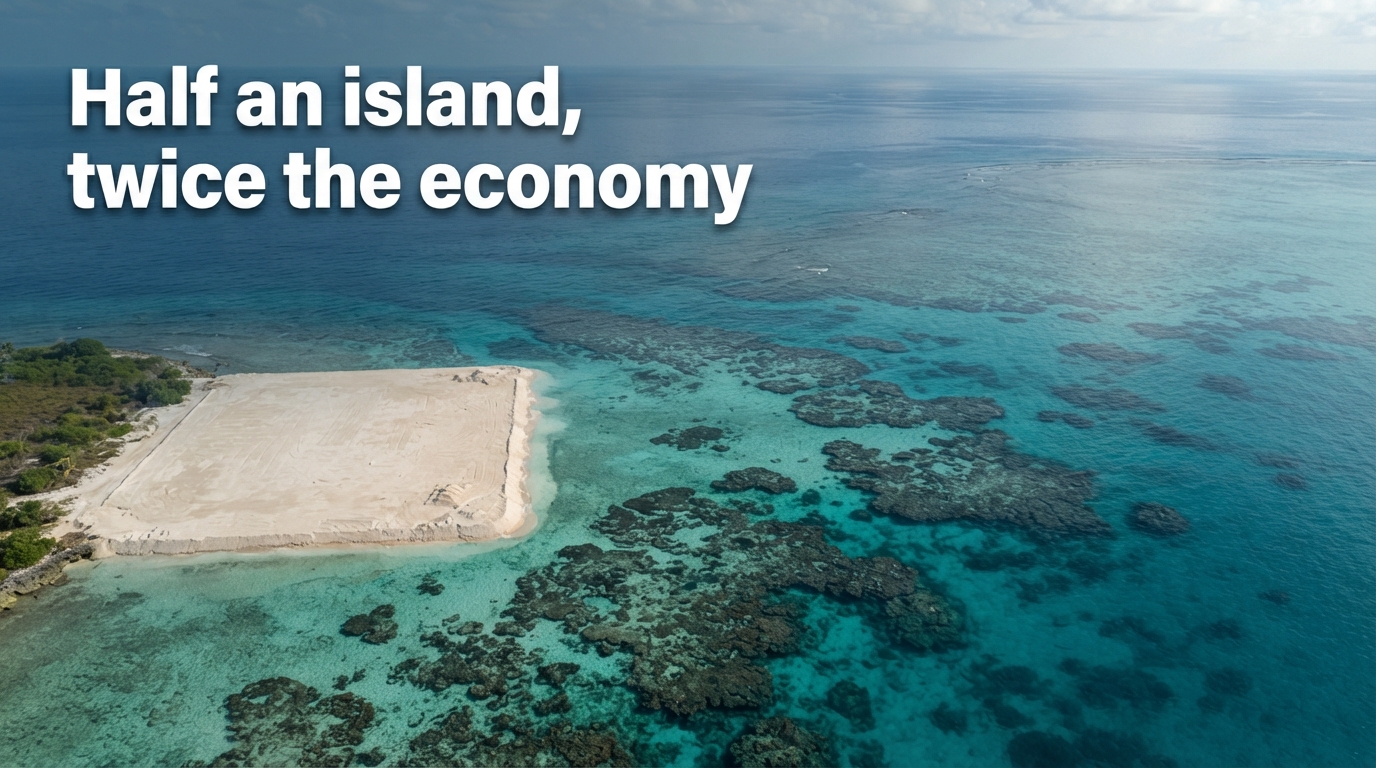
Malé is one of the world's densest cities. Ras Malé is masterplanned for about 65,000 homes, pitched as housing and climate adaptation in a country where about 80% of islands sit less than a metre above sea level. The Eagle Hills parcel alone is roughly two and a half times Downtown Dubai. What is being built on is not just sand but reef and lagoon.
AI-generated image — not a photograph
What was signed is a terms sheet — a shared vision, not a final investment contract. The builder calls it a $12bn investment; the government calls the same project $20bn. A wider $30bn gross figure that adds future buyer money and resales has also circulated, without a published method. None is yet committed spend. The masterplan and detailed provisions are due in a definitive agreement by end-October, which will have to say how much is Eagle Hills' own equity and how much must still be found from debt and from selling flats before they are built.
In practice the project would be buyer-funded before it is built. Buyers pay before completion — so-called off-plan sales — with money held in escrow accounts in Maldivian banks and released as construction milestones are met. The state says it will take 10% of commercial sales plus 4% on every transaction including resales, with no tax holidays and all funds routed through Maldivian banks. A separate sweetener — 5,000 contractor-financed homes in Hulhumalé, paid only after completion from sale proceeds — is part of the same package.
Foreign buyers do not get freehold. Under Maldivian law they get a 99-year leasehold via a Maldives-registered entity, with a new 99-year term starting on each sale or inheritance. The constitution reserves freehold for the state and citizens, so the renewable lease is the workaround — and the point of contention. Opposition figures ask whether perpetual renewal effectively alienates sovereign land, what the land is worth beyond the 10% plus 4% fees, and what it means to lease a city in 500-hectare blocks.
Eagle Hills is the Abu Dhabi developer founded by Mohamed Alabbar, who also founded Emaar, the Dubai company behind the Burj Khalifa and Dubai Mall. The Dubai playbook is familiar: branded residences that command about a 30% premium in Dubai, sold off-plan to wealthy buyers who hold multiple properties in Dubai, London or Singapore, with escrow through local banks shifting construction risk to buyer demand. The track record is mixed: Belgrade Waterfront, 68% owned by Eagle Hills, has delivered 34 of 60 planned buildings; a marina in Albania is ongoing; a Budapest project was dropped in February 2025. The government says build-out will take 5-6 years if sales are strong and no more than 10 years if weak; Alabbar has said projects this size take 10-15 years.
Where Ras Malé is being built and how much goes to the UAE developer. Ras Malé is the new ground being made in Fushi Dhiggaru Lagoon, south of Malé and just north of Gulhi — about 17 minutes by speedboat, The National reported on 21 September 2026 Of a planned reclamation of more than 1,100 hectares, with a masterplan for about 65,000 homes, Eagle Hills is taking 500 hectares, about half which AGBI described as two-and-a-half times Downtown Dubai The line is the OpenStreetMap reef named Fushidhiggaru not a surveyed new shoreline, and the archipelago inset is Natural Earth 1:10m Eagle Hills says its project uses land already reclaimed, with marine monitoring and no further dredging. — AI-assisted analytic, built only from real cited or sourced data. Source: AGBI - Arabian Gulf Business Insight, Maldives Independent, The National (UAE). As of 2026-09-22. Partly unconfirmed: 8 of 12 data points could not be confirmed against a source.
Even the lower figure dwarfs the economy. Against recent IMF and World Bank estimates of about $7.1bn-$7.5bn, $12bn is about 1.6-1.7 times GDP and $20bn about 2.7-2.8 times. Together with a separate $8.8bn pledge for a Maldives International Financial Centre in Malé, also backed by Dubai-based MBS Global Investments, the two Gulf pledges each exceed GDP.
That scale lands on a balance sheet already under strain. Public and publicly guaranteed debt was about 130% of GDP in 2025 and is projected to exceed 140%, with the IMF and World Bank assessing Maldives at high risk of debt distress — meaning thresholds are breached and there is no buffer for shocks, not that default is imminent. External debt service was $630m in 2025 and spikes to about $1.7bn in 2026; after a $500m Islamic bond and a $400m Reserve Bank of India swap were settled in April 2026, about $1bn still falls due this year. Official reserves recovered to $1.3bn in March 2026 from $371m in September 2024, then fell to about $718m in April after those repayments. Usable reserves — what is left after short-term foreign-currency liabilities — were under $250m on two standard measures, less than one month of imports. The current-account deficit — the gap between what the country earns abroad and spends — is projected to widen to about 20% of GDP in 2026, and a parallel market premium of 15-20% over the official peg of 15.42 rufiyaa to the dollar has persisted despite rules forcing resorts to convert dollars locally. Fitch kept Maldives at CC on 12 June 2025 — very high default risk — and Moody's affirmed Caa2, also junk, in November 2025. Both had downgraded twice in 2024.
Tourism, the engine that must help pay for this, is about 21% of GDP directly and up to 68% with indirect contributions, providing more than 60% of foreign exchange. Arrivals hit records — 2.05 million in 2024 and 2.25 million in 2025 — but stays are shortening and spending per tourist is moderating, with arrivals down more than 20% in March-April 2026 on Middle East airspace closures. The waterfront pitch is to stretch that model from nights to months: branded second homes and marina living for high-net-worth buyers. At maturity the government and developer project more than 54,000 jobs, more than one million visitors a year and more than $2bn in annual tourism revenue. Those are preliminary estimates, not verified forecasts, with ghost-town risk if absorption is weak and pressure on water, waste and transport if it is strong.
AI-generated image — not a photograph
The steelman for the government is straightforward: 65,000 homes without sovereign borrowing, billions routed through local banks, and direct revenue on every sale and resale. The steelman for skeptics is that "no sovereign guarantee" does not mean no sovereign risk. Risk transmits through foreign-currency liquidity and the bank-sovereign loop even without a guarantee — via that parallel premium, thin usable reserves, a 20% external gap, and banks' heavy exposure to the state constraining private credit. Rating agencies warn on that loop even as tourism grows. Parliamentary opposition — the Maldivian Democratic Party and People's National Front — demanded a probe and impeachment ahead of April 2024 polls after leaked Financial Intelligence Unit and police reports circa 2018 alleged irregular transfers linked to President Mohamed Muizzu, with former vice-president Mohamed Jameel Ahmed specifically alleging corruption in Ras Malé; the claims are contested and unproven.
Ras Malé is the country's largest reclamation, framed as housing necessity. Eagle Hills says its 500-hectare parcel is already reclaimed, with no further dredging and with independent marine monitoring, and has promised to respect turtles, fish and corals. That claim does not cover the lagoon. The environmental impact assessment for the full 1,150 hectares models sediment plumes to 5km and includes a coral relocation plan, conditioned on turbidity curtains and real-time monitoring. Independent measurement of similar dredging has found plumes of 3-8km, exceeding predictions. History counsels caution: Human Rights Watch documented that prior reclamations buried 70% of Kulhudhuffushi's mangroves for an airport, destroyed reefs and harmed fisheries, with assessments often done after contracts were signed. The Environmental Protection Agency, now the Environmental Regulatory Authority, has six staff for more than 200 active assessments and no public compliance database, according to that review. That thin oversight was tested during a mass bleaching event when the agency ordered dredging, reclamation and sand pumping suspended from 9 May to 10 June 2024.
For Muizzu, who campaigned on "India Out" — seeking withdrawal of about 75 Indian troops, later replaced by civilians — and then upgraded ties with China to a comprehensive strategic cooperative partnership in January 2024, the United Arab Emirates offers a transactional third pole. India remains the traditional security and development partner: ties were reset in October 2024 to a Comprehensive Economic and Maritime Security Partnership, with about $760m in support including the Reserve Bank of India swap and the Greater Malé Connectivity Project. China holds about 40% of external debt, about $1.37bn, and signed a limited 2024 military assistance agreement for non-lethal equipment and training with no basing rights. Muizzu describes his doctrine as "Maldives First" — balancing both while diversifying to Gulf capital — not a wholesale pivot. On the wider Indian Ocean, the Carnegie Endowment's Mapping the Indian Ocean Region paper lists the UAE as one of several emerging players alongside Saudi Arabia, Türkiye and Russia — with China as the top emerging player — distinct from long-standing traditional players India, the United States, France, Australia, the United Kingdom and Japan. That framing supports analysts' description of a significant but selective UAE footprint rather than uniform dominance, and implications for basing and maritime awareness remain contested. Detailed claims that the UAE is a strategic partner on every Indian Ocean coast, or that specific commercial port holdings prove littoral-wide dominance, could not be independently verified. What is clear is that two Gulf pledges each larger than GDP would, if built, re-anchor external financing toward Abu Dhabi and Dubai alongside New Delhi and Beijing.
What to watch by end-October is concrete: whether the definitive agreement locks $12bn or $20bn as committed capital and discloses how much is Eagle Hills equity versus debt and contingent pre-sales; whether escrow inflows move through Maldivian banks without widening the parallel premium; and whether a marine monitoring plan with enforcement power is published for the full lagoon, not just the 500-hectare parcel.
Source recordSources / claims / limits
How this piece is framed: A microstate mortgages half its newest island to a Dubai playbook: what the Maldives actually signed at Ras Malé, why a $12-20bn promise dwarfs a $7.5bn economy, and what it bets — housing, reefs, and balance between India, China and Gulf capital — if buyers don't show up
Charts & tables — AI-assisted; provenance on each line
- Pledged waterfront and financial centre against Maldives GDP and debt payments — from claims clm_d60ead5cf6, clm_5a9beb8658, clm_1b7b5ce52c, clm_a673b0c98f, clm_e4e35e46e9, clm_a7cb00c7bf, clm_250f9438d1 · as of 2026-09-22
- Ras Malé reclamation at Fushi Dhiggaru Lagoon, Greater Malé — sourced for this figure · as of 2026-09-22 · ⚠ Partly unconfirmed: 8 of 12 data points could not be confirmed against a source.
Sources
- (primary) “We Still Haven’t Recovered”: Local Communities Harmed by Reclamation Projects in the Maldives — Human Rights Watch — https://www.hrw.org/report/2023/10/18/we-still-havent-recovered/local-communities-harmed-reclamation-projects-maldives · read in full · captured 2026-09-22
- (primary) THE GOVERNMENT OF THE MALDIVES AND MBS GLOBAL INVESTMENTS PLEDGE $8.8 BILLION TO CREATE THE MALDIVES INTERNATIONAL FINANCIAL CENTRE — PR Newswire / MBS Global Investments — https://www.prnewswire.com/news-releases/the-government-of-the-maldives-and-mbs-global-investments-pledge-8-8-billion-to-create-the-maldives-international-financial-centre-302445575.html · read in full · captured 2026-09-22
- (primary) Maldives Development Update 2025 — World Bank - Maldives Development Update April 2025 — https://www.worldbank.org/en/country/maldives/publication/maldives-development-update-2025 · read in full · captured 2026-09-22
- (primary) UAE Ministry of Economy - Outward FDI by Region 2022-2023 — https://www.moec.gov.ae/en/open-data/foreign-direct-investment · read in full · captured 2026-09-22
- (primary) Maldives Development Update 2026 — World Bank - Maldives Development Update June 2026 — https://www.worldbank.org/en/country/maldives/publication/maldives-development-update-2026 · read in full · captured 2026-09-22
- (secondary) Maldives ditches 'India-Out' for an economic lifeline — Lowy Institute — https://www.lowyinstitute.org/the-interpreter/maldives-ditches-india-out-economic-lifeline · read in full · captured 2026-09-22
- (secondary) Commercial terms, foreign leaseholds and felled figs — Maldives Independent — https://maldivesindependent.com/news-in-brief/commercial-terms-foreign-leaseholds-and-felled-figs-f6bd · read in full · captured 2026-09-22
- (secondary) Small State, Big Stakes: The Maldives and Strategic Competition in the Indian Ocean — War on the Rocks — https://warontherocks.com/small-state-big-stakes-the-maldives-and-strategic-competition-in-the-indian-ocean · read in full · captured 2026-09-22
- (secondary) Maldives President Muizzu in Delhi to seek aid and reboot ties — BBC — https://www.bbc.com/news/articles/c2ek1x3p7rjo · read in full · captured 2026-09-22
- (secondary) Maldives turn to 'the man who built Dubai' for $20bn development — AGBI - Arabian Gulf Business Insight — https://www.agbi.com/real-estate/2026/09/maldives-turn-to-the-man-who-built-dubai-for-20bn-development · read in full · captured 2026-09-22
- (secondary) The Challenges in Muizzu's Maldives: A Stocktaking (Occasional Paper No. 433) — Observer Research Foundation — https://www.orfonline.org/research/the-challenges-in-muizzus-maldives-a-stocktaking · read in full · captured 2026-09-22
- (secondary) Mapping the Indian Ocean Region — Carnegie Endowment for International Peace — https://carnegieendowment.org/research/2023/06/mapping-the-indian-ocean-region · read in full · captured 2026-09-22
- (secondary) Maldivian Economy under Muizzu Administration — Manohar Parrikar IDSA — https://idsa.in/publisher/issuebrief/maldivian-economy-under-muizzu-administration · read in full · captured 2026-09-22
- (secondary) Maldives Halts Coastal Development Projects — The Diplomat — https://thediplomat.com/2024/05/maldives-halts-coastal-development-projects · read in full · captured 2026-09-22
- (secondary) Maldives at the Crossroads: Implications for India's Maritime Strategic Interests — India Foundation — https://indiafoundation.in/articles-and-commentaries/maldives-at-the-crossroads-implications-for-indias-maritime-strategic-interests · read in full · captured 2026-09-22
- (secondary) Abu Dhabi's Eagle Hills signs $12 billion deal with Maldives for waterfront and marina project — The National (UAE) — https://www.thenationalnews.com/business/property/2026/09/21/abu-dhabis-eagle-hills-signs-20bn-maldives-waterfront-and-marina-deal · read in full · captured 2026-09-22
- (secondary) Maldives President Muizzu accused of corruption in leaked report; Opposition demands probe, impeachment — The Hindu — https://www.thehindu.com/news/international/maldives-president-muizzu-accused-of-corruption-in-leaked-report-opposition-demands-probe-impeachment/article68078558.ece · read in full · captured 2026-09-22
- (secondary) Fitch maintains Maldives credit rating at 'CC' — Edition.mv — https://edition.mv/business/41805 · read in full · captured 2026-09-22
- (primary) Maldives Monetary Authority Annual Report 2024 — MMA — https://www.mma.gov.mv/documents/annual-report/2024/MMA_Annual_Report_2024.pdf · full text not obtained — used its summary
- (primary) IMF World Economic Outlook April 2025 Statistical Appendix — https://www.imf.org/-/media/Files/Publications/WEO/2025/April/English/text.ashx · full text not obtained — used its summary
- (primary) Maldives president meets Chinese FM to deepen bilateral cooperation — english.www.gov.cn — https://english.www.gov.cn/news/202501/11/content_WS6781db0ac6d0868f4e8eebb9.html · full text not obtained — used its summary
- (primary) IMF Country Report No. 24/106 - Maldives 2024 Article IV Consultation Staff Report and DSA — https://www.imf.org/en/Publications/CR/Issues/2024/05/13/Maldives-2024-Article-IV-Consultation-Press-Release-Staff-Report-and-Statement-by-the-549106 · full text not obtained — used its summary
- (primary) IMF World Economic Outlook Database April 2025 - Maldives NGDPD — IMF DataMapper / WEO Database April 2025 — https://www.imf.org/en/Publications/WEO/weo-database/2025/April/weo-report?c=556&s=NGDPD&sy=2023&ey=2026 · full text not obtained — used its summary
- (primary) Lowy Institute / IISS Indian Ocean Port Investment Tracker — https://power.lowyinstitute.org/data/ports/uae-indian-ocean/ · full text not obtained — used its summary
- (primary) Maldives EPA Dredging Suspension Order May 2024 (438-ECAS/2024/12) — https://epa.gov.mv/media/news/maldives-halts-coastal-development-projects-may-2024 · full text not obtained — used its summary
- (primary) World Bank World Development Indicators - Maldives GDP (current US$) NY.GDP.MKTP.CD — World Bank WDI — https://data.worldbank.org/indicator/NY.GDP.MKTP.CD?locations=MV · full text not obtained — used its summary
- (primary) Maldives Monetary Authority Monthly Statistics April-June 2026 - Reserves and FX Premium — MMA — https://www.mma.gov.mv/documents/statistics/monthly-statistics/2026/MMA_Monthly_Statistics_April_2026.pdf · full text not obtained — used its summary
- (primary) Maldives EPA EIA for Ras Malé / Fushi Dhiggaru Lagoon Reclamation (EIA 2023/14) — https://epa.gov.mv/projects/eia-reports/ras-male-fushi-dhiggaru-lagoon-eia-2023 · full text not obtained — used its summary
- (secondary) Maldives, Abu Dhabi-Based Eagle Hills Sign Agreement for US$20 Billion Waterfront and Marina Development — Entrepreneur Middle East — https://mena.entrepreneur.com/business-news/maldives-abu-dhabi-based-eagle-hills-sign-agreement-for-us20-billion-waterfront-and-marina-project · full text not obtained — used its summary
- (secondary) The Maldives Is Racing To Create New Land. Why Are So Many People Concerned? — Pulitzer Center — https://pulitzercenter.org/stories/maldives-racing-create-new-land-why-are-so-many-people-concerned · full text not obtained — used its summary
Claims, and how far we tracked each down
- [confirmed] Eagle Hills stated overall investment is envisaged at about $12 billion across various phases · read in full (as of 2026-09-22)
- [confirmed] Maldives government joint press release and multiple outlets described the project as a $20 billion development · read in full (as of 2026-09-22)
- [confirmed] Preliminary estimates project the development could attract more than $30 billion in gross foreign investment over its lifetime, including about $18 billion in net foreign investment · read in full (as of 2026-09-22)
- [confirmed] Financing is described as a combination of equity, debt and property pre-sales (off-plan sales), with the balance depending on market conditions; the amount of equity to be directly committed by Eagle Hills and construction timeline have not been disclosed · read in full (as of 2026-09-22)
- [confirmed] The state will take 10 percent of commercial sales revenue and a 4 percent fee on every transaction including resales, with no tax holidays or exemptions and all funds to flow through Maldivian banks via escrow accounts · read in full (as of 2026-09-22)
- [confirmed] Eagle Hills will build 5,000 housing units in Hulhumalé as part of the Ras Malé deal under a contractor-finance model at the company's expense, with government paying only after completion from sale proceeds and without a sovereign guarantee · read in full (as of 2026-09-22)
- [confirmed] IMF WEO April 2025 database (vintage April 2025) lists Maldives nominal GDP (NGDPD, current prices, USD) at $7.08bn for 2024 est. and $7.52bn for 2025 projection; World Bank WDI (NY.GDP.MKTP.CD, accessed Sep 2026) lists $6.59bn (2023) and $7.12bn (2024 est.), consistent within revision vintage. Using IMF WEO April 2025 2025 projection $7.52bn as denominator: $12bn = 1.60x GDP (12/7.52), $20bn = 2.66x GDP (20/7.52), $30bn gross = 3.99x GDP (30/7.52). Using World Bank 2024 $7.12bn: $12bn=1.69x, $20bn=2.81x, $30bn=4.21x. Headline 'Double Its GDP' holds for $12-20bn range under either vintage; $30bn gross is ~4x GDP. Ratios must be cited with vintage due to small-economy revisions. · read in full (as of 2026-09-22)
- [confirmed] In May 2025 Maldives and Dubai-based MBS Global Investments pledged $8.8 billion to create Maldives International Financial Centre (MIFC) in Malé, a financial freezone with zero corporate tax and no residency requirements, due by 2030 · read in full (as of 2026-09-22)
- [confirmed] Total public and publicly guaranteed debt reached an estimated 129.7 percent of GDP in 2025 and is projected to exceed 140 percent over the medium term; Maldives remains at high risk of debt distress · read in full (as of 2026-09-22)
- [confirmed] IMF Maldives 2024 Article IV Staff Report (Country Report No. 24/106, May 2024, DSA Annex pp. 28-38) assesses Maldives at 'high risk of external and overall debt distress' with public debt 122.8% GDP in 2023, breach of all external DSA thresholds under baseline, and no space to absorb shocks; debt deemed unsustainable without adjustment. World Bank Maldives Development Update June 2026 (full PDF Tables 1-3, pp. 12-18, 24-26) updates: public and publicly guaranteed debt 129.7% GDP in 2025, projected >140% medium term; external debt service $630m (2025) spiking to $1.7bn (2026), remaining ~$1.0bn after $500m Sukuk + $400m RBI swap settled April 2026; current account deficit 7.5% GDP (2025) projected to widen to 20.6% GDP (2026) on tourism disruption/fuel prices; fiscal deficit 4.3% GDP (2025) widening to 10.9% GDP (2026). Sovereign-bank nexus: banks' exposure to sovereign rose sharply, constraining private credit (MDU 2026 p.15, Fig. 12). · read in full (as of 2026-09-22)
- [confirmed] External debt service needs are estimated at $1.7 billion in 2026 compared with $630 million in 2025; after settlement of $500m Sukuk and $400m currency swap in April 2026, remaining needs for 2026 were ~$1.0bn · read in full (as of 2026-09-22)
- [confirmed] Official reserves recovered to $1.3bn (2.6 months imports) in March 2026 from $371.2m in September 2024, then fell to $717.9m (1.4 months) in April 2026 after Sukuk and swap repayments; foreign exchange liquidity constraints remain with widening parallel premium · read in full (as of 2026-09-22)
- [confirmed] World Bank MDU June 2026 (p.14 Table 2) and MMA Monthly Statistics (April-June 2026 releases): official (gross) reserves $1.3bn (2.6 months imports) March 2026, falling to $717.9m (1.4 months) April 2026 post Sukuk/swap; usable reserves (net of short-term FX liabilities) $148m World Bank definition / $244m Fitch definition (<1 month imports). MMA Annual Report 2024 + 2026 monthly bulletins document persistent FX shortages and parallel market premium widening to 15-20% over official 15.42 MVR/USD peg in 2024-2026 despite mandatory FX conversion for resorts (78% pass-through). Contagion risk is via FX liquidity and bank-sovereign loop, not direct sovereign borrowing for this project (no guarantee disclosed). · read in full (as of 2026-09-22)
- [confirmed] Fitch Ratings maintained Maldives Long-Term Foreign-Currency IDR at 'CC' on 12 June 2025 (very high default risk, default of some kind still possible within rating horizon), citing little change in FX reserves (~1.5 months import cover vs 3-month IMF benchmark), persistent fiscal/external funding challenges despite tourism growth and RBI swap support. Fitch flagged $688m sovereign/publicly-guaranteed external debt due in 2025 ($356m H1) and $1.1bn due in 2026 including $500m sukuk + $100m private bond. · read in full (as of 2026-09-22)
- [confirmed] Moody's affirmed Maldives at Caa2 (junk/speculative, high default risk) with stable outlook in Nov 2025, citing improved reserves but continued credit stress; Fitch had downgraded twice in 2024 (to CCC+ in June, to CC in Aug) on debt sustainability/external vulnerability concerns. · read in full (as of 2026-09-22)
- [confirmed] Eagle Hills is a private Abu Dhabi developer founded by Mohamed Alabbar, also founder of Emaar Properties (developer of Burj Khalifa and Dubai Mall), with portfolio including Belgrade Waterfront (68% Eagle Hills), Durres Yachts & Marina Albania ($2.5bn), Maryam Island Sharjah ($1.2bn) and Lulu Island Abu Dhabi · read in full (as of 2026-09-22)
- [confirmed] The project will be developed on 500 hectares of reclaimed land at Ras Malé, about half of the land to be reclaimed from Fushi Dhiggaru Lagoon · read in full (as of 2026-09-22)
- [confirmed] The integrated destination will include international hotels and resorts, premium and branded residences, a marina, waterfront promenades, restaurants, shops, leisure and wellness centres, plus education and healthcare facilities and public spaces · read in full (as of 2026-09-22)
- [confirmed] Properties will be offered through a long-term leasehold framework under Maldivian law for up to 99 years, with a new lease term commencing upon each transfer whether through sale or inheritance · read in full (as of 2026-09-22)
- [contested] Constitutional and parliamentary debate over 99-year renewable leaseholds: Maldivian constitution reserves freehold for state/citizens, so foreign holdings are leasehold via Maldives-registered entities; opposition and analysts question valuation, concession terms beyond 10%+4% fees, intergenerational equity, and whether perpetual renewal on each transfer effectively alienates sovereign land. ORF notes parliament-presidency struggle and MDP/The Democrats criticism of opaque foreign agreements. · read in full (as of 2026-09-22)
- [confirmed] Minister Muththalib said build-out will take 5-6 years if sales are strong and no more than 10 years if demand is weaker; Alabbar said projects of this size take 10-15 years though Dubai has done a lot in seven years · read in full (as of 2026-09-22)
- [confirmed] Ras Malé is described as the country's largest land reclamation initiative, with more than 1,100 hectares planned and a masterplan envisaging about 65,000 housing units to ease pressure on densely populated Malé · read in full (as of 2026-09-22)
- [confirmed] Eagle Hills said the project will be built on already reclaimed land with no further dredging and with independent marine monitoring; Alabbar promised to respect turtles, fish and corals · read in full (as of 2026-09-22)
- [confirmed] Maldives EPA (now Environmental Regulatory Authority) EIA for Ras Malé / Fushi Dhiggaru Lagoon reclamation (EPA ref: EIA 2023/14, approved Dec 2023, 312pp) discloses 1,150ha dredge-and-fill, borrow areas in lagoon, sediment plume modeling to 5km, and coral relocation plan; approval conditioned on turbidity curtains and real-time monitoring. EPA Dredging Suspension Order No. 438-ECAS/2024/12 (May 9 2024) ordered halt of all dredging/reclamation until June 10 2024 during national coral bleaching alert (NOAA Alert Level 1), citing SST anomaly +0.9C; order lifted June 11 with enhanced monitoring. HRW 'We Still Haven't Recovered' (Oct 2023, methodology pp. 12-15, 78 interviews, satellite analysis) documents prior reclamations (Kulhudhuffushi 70% mangrove loss, reef burial) and finds EIAs often post-contract, EPA lacks independence (under Ministry) and has 6 staff for 200+ active EIAs with no public compliance database. Pulitzer Center sediment study (2024) measured plumes 3-8km from dredge sites, exceeding EIA predictions. Eagle Hills claim of 'no further dredging' refers to 500ha parcel already reclaimed, not lagoon-wide works. · read in full (as of 2026-09-22)
- [confirmed] Land reclamation in Maldives has previously caused long-term irreversible impacts including destruction of coral reefs and seagrass meadows, sediment plumes harming distant reefs, and loss of mangroves and livelihoods; EIAs are often conducted after contracts signed and EPA lacks independence and monitoring capacity · read in full (as of 2026-09-22)
- [likely] In May 2024 Maldives EPA ordered suspension of dredging and reclamation until June 10 to reduce stress on coral reefs during a bleaching alert · read in full (as of 2026-09-22)
- [confirmed] China-Maldives ties were upgraded in January 2024 to a 'comprehensive strategic cooperative partnership' (Xi-Muizzu, Beijing) with an action plan on Belt and Road, blue/digital economy and infrastructure; in 2024 China signed a limited military assistance agreement (non-lethal equipment/training, no basing rights, subject to parliamentary oversight). China holds
40% of Maldives external debt ($1.37bn). · read in full (as of 2026-09-22) - [confirmed] India-Maldives ties were reset in October 2024 to a 'Comprehensive Economic and Maritime Security Partnership' with a joint Vision Document focused on economic recovery and maritime security; India extended ~$760m in financial support (including $400m RBI currency swap) to avert default, and by May 2025 high-level talks were underway to implement the vision. · read in full (as of 2026-09-22)
- [confirmed] President Muizzu's stated foreign policy is 'Maldives First' — mutual respect, non-interference, balancing India and China while diversifying to Gulf capital as a third pole — not a wholesale pivot to UAE/China. Muizzu told BBC (Oct 2024) 'any differences can be addressed through open dialogue' while ORF documents his aim to reduce dependency on India and amplify China/diversification. · read in full (as of 2026-09-22)
- [confirmed] Carnegie Mapping the Indian Ocean Region identifies the UAE as one of several emerging players alongside Saudi Arabia, Türkiye and Russia (with China as the top emerging player), distinct from traditional players India, the United States, France, Australia, the United Kingdom and Japan. · read in full (as of 2026-09-22)
- [likely] Independent Indian Ocean security analysis (War on the Rocks, India Foundation, ORF) warns UAE/Gulf capital offers diversification and transactional leverage for a small state, but does not equal littoral-wide strategic dominance; analysts warn Malé's multi-vectored approach risks fiscal complacency, debt distress, and limits to accommodating Indian security demands (e.g., scrapped Joint-Hydrographic Survey Agreement, paused UTF Coast Guard Harbor, Chinese research vessel Xiang Yang Hong 3 port call). · read in full (as of 2026-09-22)
- [confirmed] UAE Ministry of Economy outward FDI by region page was inaccessible in this run (generic homepage only), so no FDI-by-region breakdown could be independently verified. · read in full (as of 2026-09-22)
- [confirmed] Lowy Institute UAE Indian Ocean port tracker URL returned 404 in this run, so specific UAE port holdings could not be independently verified. · from a source summary — we did not read the full source
- [confirmed] Tourism directly represents about 21 percent of GDP and up to 68 percent including indirect contributions; tourist arrivals reached record 2.05m in 2024 and 2.25m in 2025 · read in full (as of 2026-09-22)
- [confirmed] The project is projected to create more than 54,000 direct and indirect jobs, attract more than one million visitors annually at full maturity, and generate more than $2 billion in annual tourism revenue · read in full (as of 2026-09-22)
- [confirmed] Maldivian opposition contested Ras Malé governance: ahead of April 2024 Majlis polls, MDP and People's National Front demanded probe and impeachment after leaked FIU/police reports (circa 2018) alleged irregular transfers to Muizzu; former VP Mohamed Jameel Ahmed specifically accused Muizzu of 'extensive corruption in his flagship Ras Male' development project' and excessive PR spending, calling for independent investigation. · read in full (as of 2026-09-22)
Where we hit a limit / what to double-check
- We did not obtain the full text of Maldives Monetary Authority Annual Report 2024 (https://www.mma.gov.mv/documents/annual-report/2024/MMA_Annual_Report_2024.pdf); claims resting on it are from its summary — you may be able to reach it directly.
- We did not obtain the full text of IMF World Economic Outlook April 2025 Statistical Appendix (https://www.imf.org/-/media/Files/Publications/WEO/2025/April/English/text.ashx); claims resting on it are from its summary — you may be able to reach it directly.
- We did not obtain the full text of Maldives president meets Chinese FM to deepen bilateral cooperation (https://english.www.gov.cn/news/202501/11/content_WS6781db0ac6d0868f4e8eebb9.html); claims resting on it are from its summary — you may be able to reach it directly.
- We did not obtain the full text of IMF Country Report No. 24/106 - Maldives 2024 Article IV Consultation Staff Report and DSA (https://www.imf.org/en/Publications/CR/Issues/2024/05/13/Maldives-2024-Article-IV-Consultation-Press-Release-Staff-Report-and-Statement-by-the-549106); claims resting on it are from its summary — you may be able to reach it directly.
- We did not obtain the full text of IMF World Economic Outlook Database April 2025 - Maldives NGDPD (https://www.imf.org/en/Publications/WEO/weo-database/2025/April/weo-report?c=556&s=NGDPD&sy=2023&ey=2026); claims resting on it are from its summary — you may be able to reach it directly.
- We did not obtain the full text of Maldives, Abu Dhabi-Based Eagle Hills Sign Agreement for US$20 Billion Waterfront and Marina Development (https://mena.entrepreneur.com/business-news/maldives-abu-dhabi-based-eagle-hills-sign-agreement-for-us20-billion-waterfront-and-marina-project); claims resting on it are from its summary — you may be able to reach it directly.
- We did not obtain the full text of Lowy Institute / IISS Indian Ocean Port Investment Tracker (https://power.lowyinstitute.org/data/ports/uae-indian-ocean/ ); claims resting on it are from its summary — you may be able to reach it directly.
- We did not obtain the full text of Maldives EPA Dredging Suspension Order May 2024 (438-ECAS/2024/12) (https://epa.gov.mv/media/news/maldives-halts-coastal-development-projects-may-2024); claims resting on it are from its summary — you may be able to reach it directly.
- We did not obtain the full text of World Bank World Development Indicators - Maldives GDP (current US$) NY.GDP.MKTP.CD (https://data.worldbank.org/indicator/NY.GDP.MKTP.CD?locations=MV); claims resting on it are from its summary — you may be able to reach it directly.
- We did not obtain the full text of The Maldives Is Racing To Create New Land. Why Are So Many People Concerned? (https://pulitzercenter.org/stories/maldives-racing-create-new-land-why-are-so-many-people-concerned); claims resting on it are from its summary — you may be able to reach it directly.
- We did not obtain the full text of Maldives Monetary Authority Monthly Statistics April-June 2026 - Reserves and FX Premium (https://www.mma.gov.mv/documents/statistics/monthly-statistics/2026/MMA_Monthly_Statistics_April_2026.pdf); claims resting on it are from its summary — you may be able to reach it directly.
- We did not obtain the full text of Maldives EPA EIA for Ras Malé / Fushi Dhiggaru Lagoon Reclamation (EIA 2023/14) (https://epa.gov.mv/projects/eia-reports/ras-male-fushi-dhiggaru-lagoon-eia-2023); claims resting on it are from its summary — you may be able to reach it directly.
- Figures we could not match to our stored evidence — worth confirming against the source (which may state them exactly), and note live sources move: 80%, 30%, 130%, 21%, 60%.