
India and China keep talking on their disputed Himalayan border, but troops stay put
The 36th round in New Delhi on 6 August produced only a promise to keep talking, leaving disengagement complete but de-escalation undone and a new dispute over a giant upstream dam on the agenda.


What happenedIndia and China held their 36th WMCC border talks in New Delhi on 6 August 2026 and agreed only to keep existing diplomatic and military channels open, with no new troop pullback or boundary deal.
Why it mattersDisengagement has stopped face-offs but left an estimated 50,000-60,000 troops on each side in place, while rival ideas about whether the border should block wider ties and a giant upstream dam keep a settlement distant.
Still openWhether keeping those channels and planned new hotlines will lead to verifiable troop thinning and delimitation, or lock in indefinite armed coexistence with added water friction.
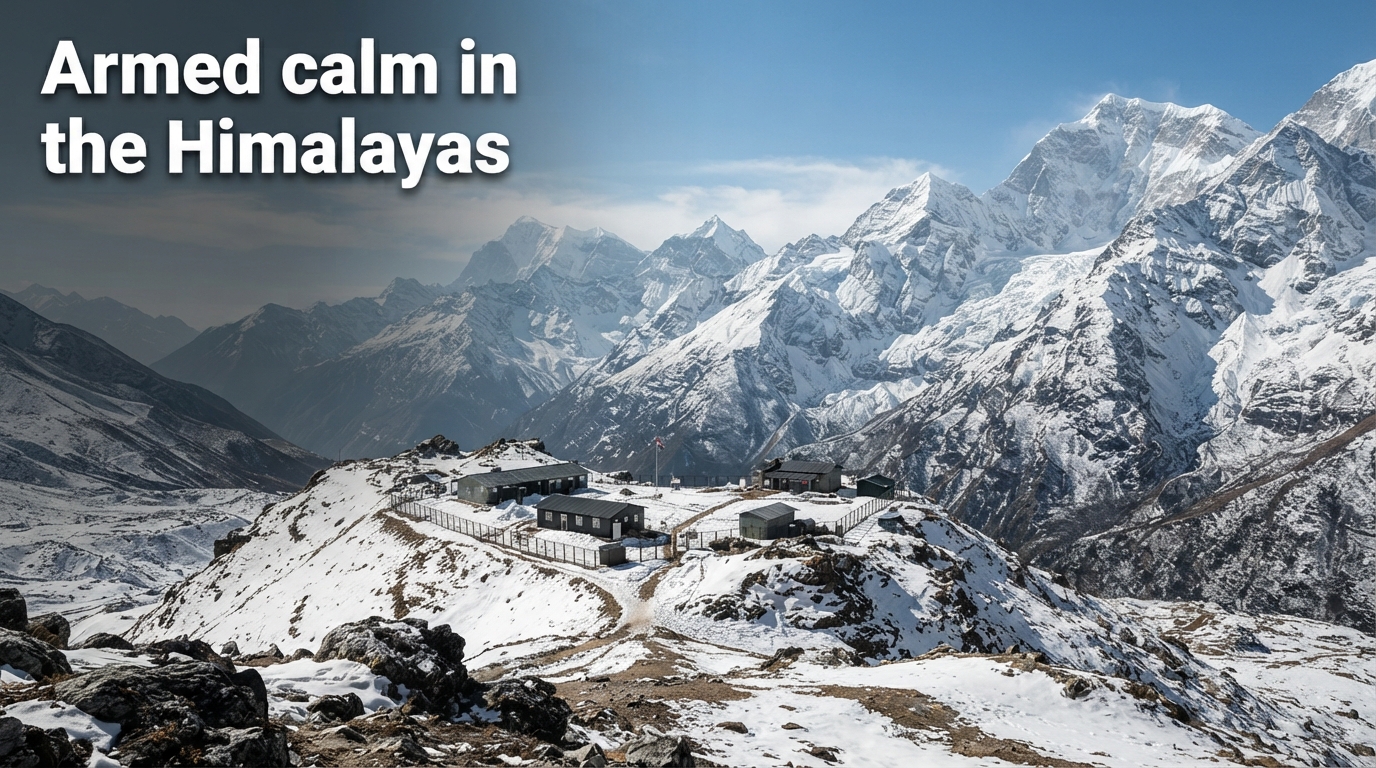
India and China held their 36th border-management talks in New Delhi on 6 August 2026 and agreed only to keep using existing diplomatic and military channels, announcing no new troop pullback or boundary deal. The result captures the state of the disputed 3,488-km Himalayan border between India and China (Line of Actual Control) today: calm enough for flights and pilgrimages to resume, but still lined with tens of thousands of troops, with a new argument over river water building alongside the old one over where the border lies. Whether all that talking turns into actual de-escalation — or locks in indefinite armed coexistence — remains open.
Where the 3,488-km Line of Actual Control runs and where the standoff was concentrated. Locator map of the undemarcated India–China Line of Actual Control (about 3,488 km by India’s count), drawn as three schematic sectors—Western (Ladakh/Aksai Chin), Middle (~625 km through Himachal/Uttarakhand), and Eastern (Sikkim/Arunachal, McMahon Line)—with the six 2020 eastern-Ladakh friction points in an inset and China’s Medog Great Bend dam site on the Yarlung Tsangpo near the Arunachal border. The takeaway: disengagement and the October 2024 coordinated-patrolling deal address a tight Ladakh cluster, not the full Himalayan front, while the new dam sits close to the Eastern Sector. Limit: LAC alignment is schematic (the line is undemarcated and perceptions differ); plotted points use published Wikipedia geocodes. Sources: Natural Earth 110m country boundaries (https://www.naturalearthdata.com/); Wikipedia geocodes — Depsang Bulge (https://en.wikipedia.org/wiki/Depsang_Bulge), Galwan River (https://en.wikipedia.org/wiki/Galwan_River), Gogra (https://en.wikipedia.org/wiki/Gogra,_Ladakh), Hot Springs (https://en.wikipedia.org/wiki/Hot_Springs,_Chang_Chenmo_Valley), Pangong Tso (https://en.wikipedia.org/wiki/Pangong_Tso), Demchok (https://en.wikipedia.org/wiki/Demchok,_Ladakh), Medog Hydropower Station (https://en.wikipedia.org/wiki/Medog_Hydropower_Station), New Delhi (https://en.wikipedia.org/wiki/New_Delhi). As of 2026-08-08. — AI-assisted analytic, built only from real cited or sourced data. Source: Vision IAS, Observer Research Foundation, Carnegie Endowment for International Peace. As of 2026-08-08.
The talks were the Working Mechanism for Consultation and Coordination on India-China Border Affairs, or WMCC — a mid-level diplomatic working group set up in 2012, led on the Indian side by Joint Secretary (East Asia) Sujit Ghosh and on the Chinese side by Hou Yanqi, director general of boundary and oceanic affairs. It is not a summit of generals or top political leaders. Its job is to keep peace along the Line of Actual Control.
That border is not a demarcated international boundary. India counts it as 3,488 km; China considers it about 2,000 km. It runs in three stretches: the Western Sector across Ladakh and Aksai Chin, the Middle Sector across Uttarakhand and Himachal Pradesh — about 625 km and largely undisputed — and the Eastern Sector across Sikkim and Arunachal Pradesh, where China rejects the McMahon Line and claims about 90,000 sq km that India administers as Arunachal. Because the line was never drawn on the ground and mapped together, patrols from both sides claim the same ground. That ambiguity is why 'disengagement' and 'delimitation' mean different things, and why settlement is structurally hard.
What broke in 2020 and what was later fixed [k2]
In March-April 2020, Chinese forces blockaded six overlapping-claim points in eastern Ladakh — Galwan Valley, the north and south banks of Pangong Tso, Gogra, Hot Springs, Depsang Bulge and Demchok — and built up about 50,000 troops without the prior notification required under 1996 confidence-building measures. India mirrored the deployment. On 15 June 2020 troops clashed in Galwan, killing 20 Indian soldiers and at least four Chinese soldiers acknowledged by Beijing, the first fatalities on the border since 1975.
Disengagement came in stages. Four points — Galwan, Pangong Tso north and south banks, Gogra and Hot Springs — were pulled back between February 2021 and September 2022 through WMCC and corps-commander talks, often by creating buffer zones where neither side patrols. Galwan, for example, saw a 1.5-km pullback on each side. Depsang and Demchok stayed deadlocked until a patrolling agreement on 21 October 2024 restored patrolling to pre-May 2020 extents and introduced a new device, coordinated patrolling, where both sides patrol the same area at different times to avoid face-offs. External Affairs Minister S. Jaishankar told the Lok Sabha on 3 December 2024 that disengagement had been 'achieved in full'.
It does not mean the border was demilitarised.
Disengaged, not de-escalated — the armed stalemate [k3]
Despite disengagement, an estimated 50,000-60,000 troops remain forward-deployed on each side in eastern Ladakh as of late 2025-2026, at what analysts describe as quasi-wartime readiness. Neither government publishes official forward-deployment figures, and there has been no independent verification; the 50,000-60,000 figure is a stakeholder estimate cited by the Carnegie Endowment and the Indian Express, not an official count. No de-escalation or de-induction — the actual thinning out and pulling back of those forces — has occurred.
The buffer zones and coordinated patrolling manage contact but do not pull forces back. And the zones themselves are contested inside India. Critics cited by the International Crisis Group argue some buffers were 'carved more out of Indian territory than Chinese,' that New Delhi 'given away patrolling rights that it previously had,' and that zones covering grazing lands have cost Ladakhi herders access, amounting in that view to territorial losses that need reciprocity and domestic justification. The official Indian position is that patrolling has been restored; the critique is that the price was uneven.
The 36th WMCC did not change that balance. Both sides said they reviewed the overall situation along the Line of Actual Control, held 'frank discussions,' and underlined that peace and tranquillity in border areas is essential for the overall development of bilateral relations — standard language in India's readout. They agreed to continue using existing diplomatic and military channels, including the WMCC, local commander-level meetings and other agreed mechanisms, to resolve outstanding issues and avoid misunderstanding and miscalculation. No new patrolling, disengagement or delimitation deal was announced.
What the 36th WMCC was — and was not [k4]
The agenda helps explain why. The talks were explicitly a follow-up to the 24th round of Special Representatives talks — the top political boundary channel, where India's National Security Adviser Ajit Doval and China's Foreign Minister Wang Yi meet — held in New Delhi on 18-19 August 2025. That round had tasked the WMCC to detail next steps on delimitation, border management, mechanism-building and trans-border cooperation.
The WMCC is the diplomatic engine in that hierarchy: political leaders set the framework, the WMCC details it, military commanders implement it on the ground. On 6 August, the Indian side reiterated one specific ask: early convening of the next meeting of the Expert Level Mechanism on trans-border rivers and sharing of technical details on China's upstream projects. That is a water issue, not a territorial one — a signal that the border file itself saw no breakthrough.
The Chinese readout of the same meeting, relayed via the Global Times, said the two sides exchanged views on boundary delineation, border management and control, mechanism building and cross-border cooperation and agreed to maintain communication through diplomatic and military channels to jointly safeguard peace and tranquillity. India's readout said border peace is essential for overall ties and pressed for river-mechanism details; China's summary omitted both.
The toolkit for managing the stalemate [k5]
What 'managing' means in practice is a set of devices now on the table:
- Buffer zones where neither side patrols, to separate forces.
- Coordinated patrolling, new in the October 2024 deal, to avoid face-offs where both claim the right to patrol.
- Hotlines and General Level Mechanisms — military commander channels. One exists in the Western Sector between the Indian Army's XIV Corps at Leh and the People's Liberation Army's South Xinjiang Military District, meeting at Chushul-Moldo. The 24th Special Representatives round agreed to create additional mechanisms in the Eastern (Sikkim/Arunachal) and Middle (Uttarakhand/Himachal) sectors and to hold an early meeting of the Western mechanism, which took place in October 2025. The eastern and middle hotlines are agreed to be created, not yet operational.
- An Expert Group under the WMCC to explore early harvest in boundary delimitation and a Working Group to advance border management.
- The Expert Level Mechanism on trans-border rivers, set up in 2006, for sharing hydrological data on the Brahmaputra and Sutlej. Under memorandums signed in 2002 and renewed in 2008, 2013 and 2018, China provides twice-daily rainfall, water level and discharge data in the monsoon from three stations in Tibet — Nugesha, Yangcun and Nuxia — with India financing collection. The Brahmaputra memorandum expired in June 2023 and renewal is pending; data sharing was suspended during the 2017 Doklam standoff and resumed in May 2018.
None of these pulls troops back by itself. They are designed to keep 60,000 troops facing each other from clashing again.
Water as the new friction — the Yarlung Tsangpo/Brahmaputra mega-dam [k6]
How India's trade deficit with China doubled even as border talks resumed. India–China bilateral trade (bars) and India’s goods trade deficit with China (line), calendar years 2019–2025, in US$ billions. Total trade rose from about $93bn to a record $155.6bn while the deficit roughly doubled from the 2020 low of $46bn to a record $116.1bn in 2025—widening even as border talks continued. Figures are China General Administration of Customs (GACC) customs data on a calendar-year basis (https://english.customs.gov.cn/); Indian April–March fiscal-year totals differ (e.g. Indian data put the FY2024–25 deficit at $99.2bn). 2019 is back-calculated from GACC year-on-year rates reported with the 2020 release; 2021–2025 are annual country tables. — AI-assisted analytic, built only from real cited or sourced data. Source: The Times of India, Reuters. As of 2026-08-08.
India's river ask points to the Yarlung Tsangpo — the same river called the Brahmaputra in India and the Jamuna in Bangladesh — and a mega-dam China is building at its Great Bend in Medog County, Tibet, less than 50 km from Arunachal Pradesh.
China approved the project on 25 December 2024 and Premier Li Qiang broke ground on 19 July 2025 at Mainling in Nyingchi. According to China's state news agency Xinhua, it comprises five cascade stations with a total investment of about 1.2 trillion yuan — about $167 billion at current rates, $137 billion at approval — and a designed annual output of about 300 billion kilowatt-hours, roughly three times the Three Gorges Dam. Electricity is planned primarily for transmission outside Tibet, with operation targeted for the 2030s. China has set up the China Yajiang Group to build and operate it.
India fears reduced dry-season flows, amplified monsoon floods, and strategic control over water for millions downstream, plus seismic and ecological risks where the river drops about 2,000 metres in 50 km through the world's deepest canyon. A Chinese geological study from the China Geological Survey warns the reservoir sits over the active Paizhen Fault, active since the Pleistocene and as recently as 9,500 years ago, citing the 2017 magnitude 6.9 Milin earthquake and risks of weakened rock and landslides. That is a single study's warning, not a consensus.
China says the dam will not have adverse downstream impacts. Foreign Ministry spokesperson Guo Jiakun said on 23 July 2025 the project follows the highest ecological standards, is a matter of sovereignty, and that China has cooperated through hydrological data sharing and will maintain communication. Envoy Yao Wen told Bangladesh the dam is run-of-river with no water withdrawal or diversion. Those are assurances, not verified outcomes.
Bangladesh, downstream of both, has asked for more. Its Ministry of Water Resources sent a formal letter in February 2025 requesting four documents — environmental impact assessment, feasibility study, climate impact assessment and disaster impact assessment — with no reply as of late March 2025, according to adviser Syeda Rizwana Hasan. The Centre for Environmental and Geographic Information Services estimates 70% of dry-season flow and more than 50% of sediment in the Ganges-Brahmaputra-Meghna basin in Bangladesh comes via the Brahmaputra, critical for delta formation. Reduced flows or sediment would affect dry-season water and erosion.
At the WMCC, India pressed for technical details through the river mechanism; China's summary did not mention the request at all.
Two doctrines, one meeting — prerequisite vs proper place [k7]
That asymmetry reflects a deeper divergence in how each capital links the border to the rest of the relationship.
New Delhi's doctrine is prerequisite: peace and tranquillity on the border is essential for the overall development of ties, and de-escalation to 'mutual and equal security' — language from the 1993 agreement — with verification is still required. Beijing's doctrine is delinking: be partners not rivals, place the boundary question in its 'appropriate' or 'proper' place so it does not affect the overall relationship, and keep communicating through diplomatic and military channels. Wang Yi has repeatedly used that formulation, including in August 2025 and June 2026, coupled with calls to initiate delimitation where conditions are met.
The same WMCC is therefore read two ways: in New Delhi as a test of whether border calm unlocks normal ties, in Beijing as a channel to safeguard calm while ties move ahead elsewhere. That is why a procedural commitment to keep talking can be presented as progress in one readout and as insufficient in the other.
Why settlement stays distant [k8]
A durable settlement would need three things that are all still far off.
First, de-escalation of the 50,000-60,000 troops on each side to mutual and equal security, with trust and verification neither side has yet agreed.
Second, new confidence-building measures and hotlines that actually cover the whole border, not just the west.
Third, delimitation and demarcation of the 3,488-km line. India and China have only exchanged maps in the Middle Sector. They disagree fundamentally in the west — over the Johnson versus McDonald lines — rival 19th-century British-drawn proposals for where the western boundary should run — and Aksai Chin, about 38,000 sq km held by China — and in the east over Arunachal. The 2005 Agreement on Political Parameters and Guiding Principles envisages a package deal covering all sectors at once. Recent talks instead explore an 'early harvest' — settling a less contentious sector first, with China having long pushed Sikkim via the 1890 Convention between Great Britain and China. India's statement after the 24th Special Representatives round said the two sides would set up an expert group to 'explore' early harvest, while also reaffirming the 2005 package-deal framework. The language is exploratory and contradictory, not an agreed shift, and critics warn that settling Sikkim alone could affect the trijunction with Bhutan at Doklam and vulnerability of the Siliguri Corridor — the narrow neck of land linking mainland India to its north-eastern states.
Analysts at Carnegie and the Observer Research Foundation describe the current diplomacy as substantive for keeping channels open but performative for settlement — attributions, not official characterisations — and point to mutual infrastructure build-up, from Chinese barracks and heliports in Ngari and Shigatse to Indian tunnels, roads and landing grounds, as a sign that both sides are digging in for a long coexistence. China's use of ambiguity as leverage is one such analytic explanation, not a primary negotiating position.
A cautious thaw around an armed border [k9]
Around the stalemate, ties have warmed transactionally since the Modi-Xi meeting in Kazan in October 2024 and again in Tianjin in August-September 2025. The Kailash Mansarovar pilgrimage has resumed, direct flights suspended since COVID are restarting, border trade at three points and visa facilitation have been discussed, and investment screening is being eased.
Economics pulls both ways. Bilateral trade hit a record $155.62 billion in calendar 2025 — Chinese exports to India $135.87 billion, Indian exports to China $19.75 billion — leaving a record Indian deficit of $116.12 billion, up from $99.21 billion in 2024 and crossing $100 billion for the second time since 2023. India depends on China for 56% of electronic components in the first half of FY2025, 93% of rare-earth magnets in FY2024-25, plus active pharmaceutical ingredients and fertilisers. China's April 2025 rare-earth export controls left 51 Indian magnet applications pending in September 2025 while flows to the United States and Germany eased after a June US-China deal, showing leverage.
Strategic competition has not eased either. India balances the Quad with the United States, Japan and Australia and its BRICS presidency in 2026 against China's Belt and Road Initiative, including the China-Pakistan Economic Corridor through Pakistan-occupied Kashmir, and ports at Hambantota and Gwadar that India sees as encirclement. China views the Quad as containment.
The 36th WMCC fits that pattern: not a step toward drawing the border, but a step toward ensuring the border, still heavily armed and now shadowed by a giant dam upstream, does not explode while both sides pursue selective cooperation elsewhere. The next tests are concrete — whether the river mechanism meets and China shares dam technical details, whether the new eastern and middle military hotlines become operational, and whether the principles for de-escalation discussed by the Special Representatives turn into a verifiable pullback. Until then, disengagement holds the line, but the line holds the troops.
Source recordSources / claims / limits
How this piece is framed: Managed stalemate, not breakthrough: disengaged but still heavily armed — how India and China are keeping the Himalayan border calm without solving it
Charts & tables — AI-assisted; provenance on each line
- The disputed Himalayan border: three sectors, six friction points, one new dam — sourced for this figure · as of 2026-08-08
- Trade up, deficit up faster: India's $116bn gap with China in 2025 — sourced for this figure · as of 2026-08-08
Sources
- (primary) India, China review LAC situation at 36th WMCC meeting in New Delhi — DD India (Prasar Bharati) — https://ddindia.co.in/2026/08/india-china-review-lac-situation-at-36th-wmcc-meeting-in-new-delhi · read in full · captured 2026-08-08
- (primary) Chinese premier announces construction of Yarlung Zangbo hydropower project — Xinhua (english.news.cn) — http://english.news.cn/20250719/a2e4342fa63a492c95f646c73bd3313c/c.html · read in full · captured 2026-08-08
- (primary) India reiterates need for China's upstream project details, as both sides discuss LAC stability, border issues at 36th WMCC — ANI via aninews.in — https://www.aninews.in/news/world/asia/india-reiterates-need-for-chinas-upstream-project-details-as-both-sides-discuss-lac-stability-border-issues-at-36th-wmcc20260807115900 · read in full · captured 2026-08-08
- (primary) Indian Prime Minister Narendra Modi Meets with Wang Yi - Ministry of Foreign Affairs of the People's Republic of China — https://www.fmprc.gov.cn/eng/wjbzhd/202508/t20250820_11693025.html · read in full · captured 2026-08-08
- (secondary) Thin Ice in the Himalayas: Handling the India-China Border Dispute - International Crisis Group Report 334 — https://www.crisisgroup.org/rpt/asia/south-asia/india-china/334-thin-ice-himalayas-handling-india-china-border-dispute · read in full · captured 2026-08-08
- (secondary) India, China to use diplomatic, military channels to resolve outstanding border issues: MEA — Hindustan Times — https://www.hindustantimes.com/india-news/india-china-to-use-diplomatic-military-channels-to-resolve-outstanding-border-issues-101786082401188.html · read in full · captured 2026-08-08
- (secondary) India-China: the need for a border settlement — The Hindu — https://www.thehindu.com/news/international/india-china-the-need-for-a-border-settlement/article70025656.ece · read in full · captured 2026-08-08
- (secondary) China begins construction on world's largest dam in Tibet — Deutsche Welle — https://www.dw.com/en/china-begins-construction-on-worlds-largest-dam-in-tibet/a-73349445 · read in full · captured 2026-08-08
- (secondary) China approves world's largest, $137-billion dam on the Brahmaputra close to the Indian border — The Hindu — https://www.thehindu.com/news/international/china-approves-worlds-largest-dam-worth-137-billion-over-brahmaputra-river-close-to-indian-border/article69029477.ece · read in full · captured 2026-08-08
- (secondary) India, China agree to maintain stability along LAC, continue existing border mechanisms — The Indian Express — https://indianexpress.com/article/india/india-china-maintain-stability-lac-existing-border-mechanisms-10333567 · read in full · captured 2026-08-08
- (secondary) Bangladesh expresses concern over China's Brahmaputra Dam project — Asia News Network / Daily Star — https://asianews.network/bangladesh-expresses-concern-over-chinas-brahmaputra-dam-project · read in full · captured 2026-08-08
- (secondary) Diplomacy, Sanctions, and Military Might: India's Post-Galwan Strategies in Managing China (ORF Occasional Paper 508) — Observer Research Foundation — https://www.orfonline.org/research/diplomacy-sanctions-and-military-might-india-s-post-galwan-strategies-in-managing-china · read in full · captured 2026-08-08
- (secondary) India-China trade: India's exports to China rise in 2025, deficit climbs to record $116 bn — The Times of India — https://timesofindia.indiatimes.com/business/india-business/india-china-trade-indias-exports-to-china-rise-in-2025-deficit-climbs-to-record-116-bn/articleshow/126530984.cms · read in full · captured 2026-08-08
- (secondary) India-China Relations in Water Management: from Conflict to Cooperation — NatStrat — https://www.natstrat.org/articledetail/publications/india-china-relations-in-water-management-from-conflict-to-cooperation-187.html · read in full · captured 2026-08-08
- (secondary) Dam on upper reaches Brahmaputra will not impact India, Bangladesh: China — The Hindu — https://www.thehindu.com/news/international/dam-on-upper-reaches-brahmaputra-will-not-impact-india-bangladesh-china/article69848041.ece · read in full · captured 2026-08-08
- (secondary) China's Brahmaputra mega dam: Can it control river water flowing into India? — Times of India — https://timesofindia.indiatimes.com/india/chinas-brahmaputra-mega-dam-can-it-control-river-water-flowing-into-india/articleshow/132407062.cms · read in full · captured 2026-08-08
- (secondary) India, China hold fresh border talks; New Delhi raises concerns over mega dam project — CNBC-TV18 — https://www.cnbctv18.com/india/india-china-hold-fresh-border-talks-new-delhi-raises-concerns-over-mega-dam-project-19964123.htm · read in full · captured 2026-08-08
- (secondary) Wang Yi calls for India, China to accelerate resumption of stalled dialogue mechanisms - The Hindu — https://www.thehindu.com/news/international/wang-yi-calls-for-india-china-to-accelerate-resumption-of-stalled-dialogue-mechanisms/article71135953.ece · read in full · captured 2026-08-08
- (secondary) China, India hold meeting on border affairs, pledge to jointly safeguard peace and tranquility in border areas - Global Times — https://www.globaltimes.cn/page/202608/1367733.shtml · read in full · captured 2026-08-08
- (secondary) China begins construction of world's largest hydropower project — International Water Power — https://www.waterpowermagazine.com/news/china-begins-construction-of-worlds-largest-hydropower-project · read in full · captured 2026-08-08
- (secondary) India, China discuss LAC situation and border management during diplomatic talks: MEA — The Hindu — https://www.thehindu.com/news/national/india-china-discuss-lac-situation-and-border-management-during-diplomatic-talks-mea/article71316535.ece · read in full · captured 2026-08-08
- (secondary) What is China's 'Early Harvest' Proposal for Border Talks That Modi Govt Has Now Conceded? — The Wire — https://m.thewire.in/article/diplomacy/what-is-chinas-early-harvest-proposal-for-border-talks-that-modi-govt-has-now-conceded · read in full · captured 2026-08-08
- (secondary) Ahead of President Xi's arrival, India and China agree to maintain border peace to boost ties - Tibetan Review — https://www.tibetanreview.net/ahead-of-president-xis-arrival-india-and-china-agree-to-maintain-border-peace-to-boost-ties · read in full · captured 2026-08-08
- (secondary) Threading the Needle: India's Path Forward with China — Carnegie Endowment for International Peace — https://carnegieendowment.org/india/research/2026/07/threading-the-needle-indias-path-forward-with-china · read in full · captured 2026-08-08
- (secondary) China starts building world's largest dam, fuelling fears in India — BBC — https://www.bbc.com/news/articles/c4gk1251w14o · read in full · captured 2026-08-08
- (tertiary) India-China Agreement on Line of Actual Control (LAC) — Vision IAS — https://visionias.in/current-affairs/monthly-magazine/2024-11-14/international-relations/india-china-agreement-on-line-of-actual-control-lac · read in full · captured 2026-08-08
- (secondary) India trade deficit with China widens to record $99.2 bln amid dumping concerns — Reuters — https://www.reuters.com/markets/asia/india-trade-deficit-with-china-widens-record-992-bln-amid-dumping-concerns-2025-04-16 · full text not obtained — used its summary
- (secondary) India, China discuss border issues, upstream river projects at key talks — Hindustan Times — https://www.hindustantimes.com/india-news/india-asks-china-to-share-details-of-upstream-water-projects-at-wmcc-meet-101786128035732.html · full text not obtained — used its summary
Claims, and how far we tracked each down
- [confirmed] The 36th WMCC meeting on India-China Border Affairs was held in New Delhi on 6 August 2026, announced by MEA on 7 August 2026 · read in full (as of 2026-08-08)
- [confirmed] No new disengagement, de-escalation or delimitation agreement was announced at the 36th WMCC; outcome was procedural commitment to continue dialogue · read in full (as of 2026-08-08)
- [confirmed] Despite disengagement, de-escalation has not been completed; an estimated 50,000-60,000 troops remain forward-deployed on each side along the LAC in eastern Ladakh as of late 2025-2026 · read in full (as of 2026-08-08)
- [likely] Estimated 50,000-60,000 troops remain forward-deployed on each side along LAC in eastern Ladakh as of late 2025-2026 - stakeholder estimate, not officially confirmed, no independent verification, quasi-wartime readiness with no de-escalation · read in full (as of 2026-08-08)
- [confirmed] The Indian delegation was led by Sujit Ghosh, Joint Secretary (East Asia), MEA; the Chinese delegation by Hou Yanqi, Director General of Boundary and Oceanic Affairs, Chinese MFA · read in full (as of 2026-08-08)
- [confirmed] The talks were diplomatic-level WMCC talks, not military corps-commander talks or Special Representatives talks · read in full (as of 2026-08-08)
- [confirmed] The LAC is 3,488 km long according to India (China considers it ~2,000 km), divided into Western (Ladakh/Aksai Chin), Middle (Uttarakhand/Himachal, ~625 km, largely undisputed) and Eastern (Sikkim/Arunachal, McMahon Line) sectors · read in full (as of 2026-08-08)
- [confirmed] India and China reached a patrolling agreement on 21 October 2024 for Depsang Bulge and Charding-Ninglung Nala junction near Demchok, the last two of six friction points blockaded by PLA in March-April 2020 · read in full (as of 2026-08-08)
- [confirmed] The Galwan Valley clash on 15 June 2020 killed 20 Indian soldiers and at least 4 Chinese soldiers (China officially acknowledged 4), the first fatalities on the LAC since 1975 · read in full (as of 2026-08-08)
- [confirmed] Disengagement at the other four friction points (Galwan Valley, Pangong Tso north/south banks, Gogra PP17A, Hot Springs PP15) was completed between February 2021 and September 2022 · read in full (as of 2026-08-08)
- [likely] Buffer zones where neither side patrols were created at several disengagement points (e.g., Galwan 1.5 km each side), and the October 2024 agreement introduced coordinated patrolling to avoid face-offs · read in full (as of 2026-08-08)
- [confirmed] External Affairs Minister S. Jaishankar stated on 3 December 2024 that disengagement had been achieved in full in eastern Ladakh · read in full (as of 2026-08-08)
- [contested] On buffer zones and disengagement, Indian official view (Jaishankar 3 Dec 2024 'disengagement achieved in full' clm_aca9aefaf4, patrolling restored to pre-May 2020 extents via coordinated patrolling) is contested domestically. Credible critics cited by International Crisis Group argue some buffer zones are 'carved more out of Indian territory than Chinese,' that New Delhi 'given away patrolling rights that it previously had,' that zones encompass grazing lands affecting Ladakhi livelihoods, and that zones are 'tantamount to territorial losses' requiring reciprocity and domestic justification. This dissent qualifies the profile's presentation of disengagement as unambiguously restoring status quo ante. · read in full (as of 2026-08-08)
- [confirmed] Both sides reviewed the overall situation along the LAC and held frank discussions, underlining that peace and tranquillity in border areas is essential for overall bilateral relations · read in full (as of 2026-08-08)
- [confirmed] MEA verbatim for 36th WMCC (New Delhi, 6 Aug 2026, released 7 Aug 2026) states: 'The two sides engaged in frank discussions and reviewed the situation along the Line of Actual Control (LAC). Further, it was underlined that maintaining peace and tranquillity in the border areas is essential for the overall development of bilateral relations' and 'Both sides agreed to continue to use existing diplomatic and military channels, including the WMCC, local commander-level meetings and other agreed mechanisms, to resolve outstanding issues and avoid misunderstanding and miscalculation along the LAC.' Agenda is described as follow-up to 24th SR Talks covering boundary delimitation, border management, mechanism-building and trans-border cooperation, with Indian side reiterating need for early Expert Level Mechanism on trans-border rivers and sharing technical details on upstream projects. · read in full (as of 2026-08-08)
- [confirmed] Both sides agreed to continue using existing diplomatic and military channels, including WMCC, local commander-level meetings and other agreed mechanisms, to resolve outstanding issues and avoid misunderstanding and miscalculation along the LAC · read in full (as of 2026-08-08)
- [likely] The 24th round of Special Representatives talks was held in New Delhi on 18-19 August 2025 between NSA Ajit Doval and Foreign Minister Wang Yi, reaching ten points of consensus including expert/working groups on delimitation and border management · read in full (as of 2026-08-08)
- [confirmed] Discussions covered boundary delimitation, border management, mechanism-building and trans-border cooperation as follow-up to the 24th Special Representatives talks · read in full (as of 2026-08-08)
- [confirmed] India reiterated need for early convening of the Expert Level Mechanism on trans-border rivers and sharing of technical details on China's upstream projects · read in full (as of 2026-08-08)
- [confirmed] MEA verbatim at 36th WMCC (New Delhi Aug 6 2026, released Aug 7 2026): Indian side reiterated need for early convening of next meeting of Expert Level Mechanism on trans-border rivers and emphasized importance of sharing technical details on upstream projects; talks also covered boundary delimitation, border management, mechanism-building and trans-border cooperation as follow-up to 24th SR Talks · read in full (as of 2026-08-08)
- [confirmed] Chinese Foreign Ministry readout for same 36th WMCC (relayed Aug 7 2026 via Global Times) states: 'The two sides exchanged views on issues including boundary delineation, border management and control, mechanism building, and cross-border cooperation' and 'Both sides agreed to maintain communication through diplomatic and military channels and work together to jointly safeguard peace and tranquility in the border areas.' The Chinese summary omits MEA's 'essential for overall development of bilateral relations' linkage and omits any mention of India's Expert Level Mechanism / upstream dam technical-details ask. · read in full (as of 2026-08-08)
- [likely] Comparison shows framing divergence: India conditions overall bilateral development on border peace and tranquillity; China frames border as issue to be jointly safeguarded and placed in 'appropriate position' so it does not affect overall ties. This delinking vs prerequisite contrast is explicit in Wang Yi's repeated formulations, not in the terse 36th WMCC Chinese readout itself. · read in full (as of 2026-08-08)
- [likely] India and China agreed at the 24th SR talks to set up an Expert Group under WMCC to explore early harvest in boundary delimitation and a Working Group to advance border management, plus additional General Level Mechanisms in Eastern and Middle sectors · read in full (as of 2026-08-08)
- [confirmed] Expert Level Mechanism on trans-border rivers established 2006; Brahmaputra MoU signed 2002 (renewed 2008, 2013, 2018; expired June 2023, renewal pending) provides twice-daily rainfall/water level/discharge data June-Oct (expanded to May 15-Oct 15 under 2013 umbrella MoU) from three Tibetan stations Nugesha, Yangcun, Nuxia; Sutlej MoU 2005 (Tsada station) expired 2020; India finances data collection; Implementation Plans operationalized by Central Water Commission; data sharing suspended during 2017 Doklam standoff and resumed May 15 2018 after 11th ELM in Hangzhou · read in full (as of 2026-08-08)
- [confirmed] Project located at Medog County Great Bend around Namcha Barwa where Yarlung Tsangpo drops ~2,000m in ~50km within world's deepest canyon, close to LAC in Arunachal Pradesh sector (nearest Indian locations Gelling/Norbuling/Bishing). Chinese geological study (China Geological Survey, Sedimentary Geology and Tethyan Geology) identifies active Paizhen Fault beneath reservoir area, active since Pleistocene/Holocene (movement as recent as 9,500 years ago), 2017 M6.9 Milin earthquake cited, warning of weakened rock and landslide/rock-collapse risk · read in full (as of 2026-08-08)
- [confirmed] Chinese government approved Yarlung Zangbo hydropower project Dec 25 2024 (Xinhua) and Premier Li Qiang announced start of construction at groundbreaking at Mainling hydropower station, Nyingchi City, Xizang on July 19 2025. Project comprises five cascade stations, total investment
1.2tn yuan ($167.8bn; $137bn at approval), designed annual output ~300bn kWh, electricity primarily for external transmission, China Yajiang Group Co. Ltd inaugurated in Beijing to build/operate · read in full (as of 2026-08-08) - [likely] China is building mega hydropower dam on Yarlung Tsangpo at Great Bend in Medog County, Tibet - five cascade stations,
300bn kWh/year (3x Three Gorges), cost 1.2tn yuan ($167.8bn; $137bn at Dec 2024 approval), approved Dec 25 2024, groundbreaking July 19 2025 by Premier Li Qiang at Mainling, Nyingchi · read in full (as of 2026-08-08) - [confirmed] Chinese MFA spokesperson Guo Jiakun (July 23 2025 briefing) said project will not have any negative impact on downstream regions, China has cooperated via hydrological data sharing and flood prevention, will maintain communication and enhance cooperation, follows highest ecological standards, is matter of sovereignty; earlier Mao Ning (Dec 27 2024) cited responsible attitude and extensive scientific/environmental assessments; envoy Yao Wen assured Bangladesh July 21 2025 dam is run-of-river with no water withdrawal/diversion · read in full (as of 2026-08-08)
- [confirmed] Bangladesh Ministry of Water Resources sent formal letter Feb 2025 requesting four documents - EIA, feasibility study, climate impact assessment, disaster impact assessment - no reply as of March 28 2025 (adviser Syeda Rizwana Hasan); CEGIS notes 70% of dry-season flow of Ganges-Brahmaputra-Meghna basin in Bangladesh comes via Brahmaputra and >50% of sediment via Brahmaputra, critical for delta formation; disruption risks reduced dry-season flows and increased erosion · read in full (as of 2026-08-08)
- [confirmed] China's consistent official framing (Wang Yi Aug 19 2025 FMPRC readout and June 22-23 2026 statement) is: 'adhere to correct positioning of being partners, not rivals,' 'prudently manage differences to ensure boundary disputes do not affect overall relationship,' and 'place the China-India boundary issue in its appropriate position / proper place and prevent it from affecting overall situation of bilateral relations,' coupled with 'initiating boundary delimitation negotiations in areas where conditions are met' (early harvest). This represents the credible alternative to India's 'peace prerequisite' narrative. · read in full (as of 2026-08-08)
- [likely] Early harvest proposal is a Chinese-origin concept to settle Sikkim sector first by replacing the 1890 Great Britain-China Convention with a new China-India agreement (first publicly floated by Ambassador Luo Zhaohui 2017, clarified by Sr Col Zhao Xiaozhou, formally submitted to Jaishankar Aug 2019). Indian historical position treated this as violating the 2005 Agreement on Political Parameters and Guiding Principles which envisages a package deal covering all sectors (Articles IV/VII on mutual and equal security and settled populations, implying as-is-where-is swap of Aksai Chin/Arunachal). The Aug 19 2025 SR decision to set up an Expert Group under WMCC to 'explore Early Harvest of boundary delimitation on appropriate Sectors' is therefore a departure from package-deal principle, with strategic risks cited regarding trijunction at Batang La/Jhampheri ridge, Siliguri corridor vulnerability, and Bhutan's Doklam interests. · read in full (as of 2026-08-08)
- [likely] Claims that China's 'use of ambiguity as leverage' explains settlement distance and that 36th WMCC language is 'contradictory' and 'performative in not advancing' are interpretive attributions to Carnegie/ORF analysis (Threading the Needle, ORF Occasional Paper 508), not primary negotiating positions. Primary readouts announce no breakthrough (clm_bcef1113e7) but do not characterize talks as performative; Carnegie itself notes language is exploratory ('explore' early harvest) and that dual-track approach is new. Settlement distance also reflects mutual infrastructure build-up and 50-60k forward deployments on each side, not solely Chinese ambiguity. · read in full (as of 2026-08-08)
- [likely] No new disengagement, de-escalation or delimitation agreement was announced at 36th WMCC; outcome was procedural commitment to continue dialogue (fact). Whether this reflects 'substantive channel-keeping' vs 'performative' stasis is inference. Distinguishing fact from inference, and attributing leverage/ambiguity thesis to secondary analysis while presenting Chinese delinking/early-harvest and Indian buffer-zone critique as competing credible framings, provides adversarial completeness. · read in full (as of 2026-08-08)
- [confirmed] India-China bilateral trade reached $155.62 billion in calendar 2025, with Chinese exports to India $135.87 billion and Indian exports to China $19.75 billion, yielding a record Indian deficit of $116.12 billion · read in full (as of 2026-08-08)
- [confirmed] India's trade deficit with China was $99.21 billion in 2024 (Chinese exports $113.45bn, Indian exports $14.25bn) and $99.2 billion in FY2024-25 per Indian data · read in full (as of 2026-08-08)
Where we hit a limit / what to double-check
- We did not obtain the full text of India trade deficit with China widens to record $99.2 bln amid dumping concerns (https://www.reuters.com/markets/asia/india-trade-deficit-with-china-widens-record-992-bln-amid-dumping-concerns-2025-04-16); claims resting on it are from its summary — you may be able to reach it directly.
- We did not obtain the full text of India, China discuss border issues, upstream river projects at key talks (https://www.hindustantimes.com/india-news/india-asks-china-to-share-details-of-upstream-water-projects-at-wmcc-meet-101786128035732.html); claims resting on it are from its summary — you may be able to reach it directly.
- Figures we could not match to our stored evidence — worth confirming against the source (which may state them exactly), and note live sources move: 56%, 93%.