
Reef corals breathe by spinning tiny vortices — heat can break the pump
Scientists filmed the cilia-driven pump in the boulder coral Porites lutea and found it speeds up then fails above about 37C in acute lab warming in darkness, shifting oxygen supply from stirring to slow diffusion — a threshold that varies by species and conditions.
What happenedScientists filmed reef corals beating tiny hair-like cilia to spin vortices that pull oxygen to tissue at night, and found acute warming above about 37C breaks coordination and collapses the vortices.
Why it mattersIt gives a concrete reason why marine heatwaves can kill corals quickly by suffocation at night — not just bleaching — and why a few degrees matters once the pump fails.
Still openWhether the ~37C collapse and rapid anoxia seen in acute lab warming of the boulder coral Porites lutea in darkness holds for other species, slower warming, or daytime reefs where photosynthesis adds oxygen.
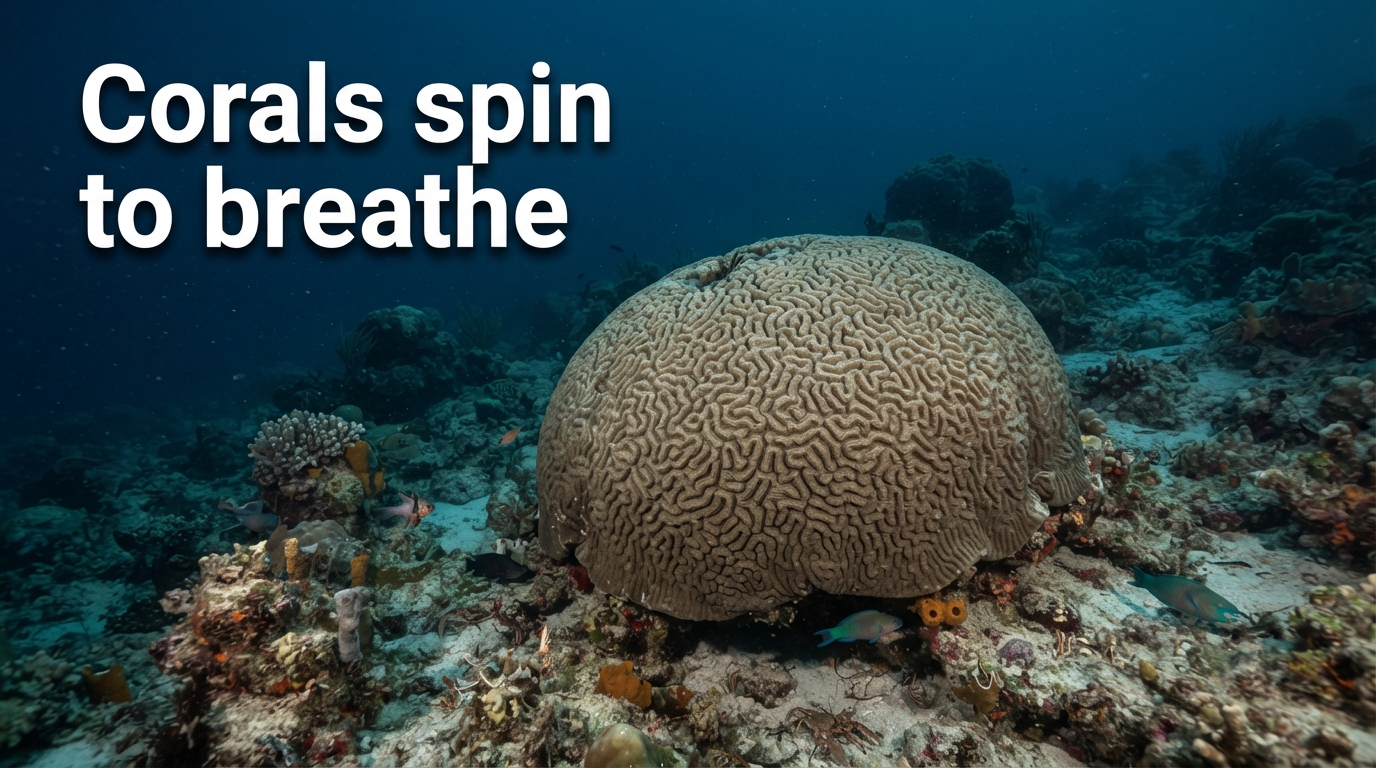
Scientists have directly watched how reef corals use tiny hair-like cilia to breathe at night — beating in coordinated waves to spin vortices that pull oxygen to their tissue — and found acute warming above about 37C breaks that coordination, dissipates the vortices and cuts oxygen supply until tissue goes anoxic. It gives a concrete, holdable reason why marine heatwaves can kill corals quickly by suffocation at night, not just by bleaching, and why a few degrees matters once the pump fails. Whether that collapse point seen in acute lab warming of one species in darkness holds for other corals, slower warming, or daytime reefs where algae make oxygen is not yet established.
How a coral breathes at night
A reef-building coral looks still, but its surface is covered with thousands of cilia — flexible hairs 10 to 15 micrometres long, about 500 times thinner than a human hair — that beat in coordinated, wave-like patterns. When they beat together they stir the thin layer of water right against the tissue, the concentration boundary layer, where oxygen is depleted and must be refreshed by mixing. The stirring forms tiny vortices, roughly 1,000 to 1,200 micrometres long and 400 to 900 micrometres high, that draw oxygen-rich water from outside the layer into contact with the tissue.
That active ventilation matters most at night. By day, algae living inside the coral make oxygen by photosynthesis. At night, with photosynthesis off, the coral depends entirely on pulling oxygen from the surrounding seawater, and the cilia-driven vortices are the pump that makes that possible. Without them, exchange would rely on slow passive diffusion across the boundary layer.
How the pump was watched
The finding comes from a study published 20 May 2026 in Science Advances by Cesar Pacherres, an assistant professor at the University of Copenhagen, and colleagues including senior author Michael Köchl, professor of biology at the University of Copenhagen, with co-authors at the Leibniz Institute for Baltic Sea Research, the University of Melbourne and KAUST, the King Abdullah University of Science and Technology in Saudi Arabia.
The team worked with the reef-building coral Porites lutea — the massive boulder coral used for all the lab experiments here, not a survey of many species — under acute warming in darkness. They combined high-speed imaging of cilia beating with a technique called SensPIV, which tracks glowing O2-sensitive nanoparticles to map water flow and oxygen concentration at the same time, and a two-dimensional transport model that couples ciliary flow to tissue respiration.
Faster beating, worse oxygen — the paradox
Moderate warming did not slow the cilia at first. It sped them up.
Cilia beating frequency rose linearly by about 1 Hz per degree, from 20.78 ± 1.35 Hz at 27C to 30.54 ± 3.14 Hz at 37C, a temperature coefficient (Q10) of 1.51. The vertical component of the vortex flow rose with it, from about 440 micrometres per second at 27C to 499 at 32C and 601 ± 5 at 35C (Q10 1.48).
Yet oxygen around the tissue got worse, not better. The layer of oxygen-depleted water — defined as below 50% air saturation — thickened from about 1,000 micrometres at 27C to about 1,200 micrometres at 32C to 35C, exposing tissue to transient hypoxia. The reason is demand outpacing supply: warming raises the coral's respiration faster than the faster pump can resupply oxygen, so the vortices circulate increasingly low-oxygen water and trap it near the surface. By 37C, the vertical velocity had already fallen back to about 400 micrometres per second as rhythmicity began to break down, particularly at the tips and middles of the cilia.
In other words, the coral breathes harder but still suffocates more.
The cliff above about 37C
Above about 37C, coordination collapsed. Cilia slowed, lost synchrony and eventually stopped. Vortical flows dissipated — absent altogether at about 39C, where vertical velocity fell to near zero — and oxygen transport shifted from being dominated by stirring to being limited by diffusion.
The team quantifies that shift with the Sherwood number, Sh — the ratio of total oxygen transport to what diffusion alone would deliver. High Sh means the pump dominates; Sh near 3 means almost diffusion-only. In the experiments Sh was about 137 at 27C, 366 at 32C, 152 at 35C and 128 at 37C, with advection — transport by the stirring flow (as opposed to passive diffusion) — contributing more than 99% of transport. At 39C, Sh fell to about 3, with advection down to about 75%.
The boundary layer thinned as stirring stopped — to about 600 micrometres at 39C — which slightly increased diffusive exchange, but after the coral had lost its buffering capacity. In the model, anoxic tissue expanded rapidly beyond this threshold, and in the lab, corals showed little to no cilia movement at 41C with 100% mortality in the acute ramp.
The sequence is abrupt, not gradual: enhanced ventilation that becomes detrimental, then a sudden loss of vortical mixing, then diffusion-limited supply and rapid anoxia.
Why a few degrees can kill — and why 37C is not a universal death line
That mechanism helps explain rapid heatwave kills that have often been attributed only to bleaching — the breakdown of the coral-algal symbiosis under oxidative stress. Oxygen stress and bleaching are linked, the authors note, and oxygen stress may intensify bleaching or cause severe damage before bleaching is visible. Because the pump is essential at night, warming plus the global decline in ocean oxygen can interact: even when bulk seawater remains well-oxygenated, the coral's own boundary layer can become hypoxic, and when ambient oxygen is already low, tissue oxygen limitation arrives sooner.
But the temperatures are not a fixed lethal line for all reefs. The press release and paper emphasize the threshold is not universal and varies with local temperature history, long-term adaptation and species composition. The ~37C coordination collapse, ~39C vortex loss and 41C mortality were observed in Porites lutea under acute, stepwise warming in darkness in the lab, at low ambient flow typical of sheltered reefs. Chronic, gradual warming might allow acclimation, and daytime conditions where photosynthesis can push the boundary layer toward hyperoxia — oxygen supersaturation — change the oxygen balance in ways the dark experiments do not capture. The model also shows the anoxia threshold shifts by several degrees depending on how steeply respiration rises with temperature.
What is established is the pump itself — corals actively regulate oxygen exchange by stirring the boundary layer rather than relying solely on passive diffusion — and that this pump is thermally fragile. What is supported is the two-phase heat response: faster beating that still thickens the hypoxic layer, then a collapse to diffusion-limited transport and rapid anoxia. Whether that plays out at the same temperature on a wild reef, and how much of field mortality during marine heatwaves traces to this suffocation pathway versus bleaching alone, remains to be tested across species and field conditions. The authors suggest changes in ciliary motion could serve as an early warning of thermal stress before visible damage, and that species or morphologies with more robust ciliary function may be more resilient where warming and deoxygenation coincide.
Source recordSources / claims / limits
How this piece is framed: Mechanism revealed: how corals breathe by spinning vortices — and the thermal breaking point where the pump fails
Sources
- (primary) Acute temperature effects on cilia beating increase coral deoxygenation — Science Advances — https://www.science.org/doi/10.1126/sciadv.aeg0950 · read in full · captured 2026-08-06
- (primary) Warming oceans can disrupt coral oxygen supply and trigger coral death (EurekAlert! distribution) — https://www.eurekalert.org/news-releases/1128393 · read in full · captured 2026-08-06
- (primary) Warming oceans can disrupt coral oxygen supply and trigger coral death — University of Copenhagen — https://www1.bio.ku.dk/english/news/2026/warming-oceans-can-disrupt-coral-oxygen-supply-and-trigger-coral-death · read in full · captured 2026-08-06
Claims, and how far we tracked each down
- [confirmed] Corals actively regulate oxygen and metabolite exchange across the coral-water interface via cilia-induced vortical flows that stir the concentration boundary layer (CBL), rather than relying solely on passive diffusion. · read in full (as of 2026-08-06)
- [confirmed] Institutional press release confirms critical thermal threshold at approximately 37�b0C where cilia slowed, lost synchrony and stopped, causing dramatic drop in oxygen supply, tissue breakdown and coral death; threshold is not universal and varies with local temperature, adaptation and species composition. · read in full (as of 2026-08-06)
- [confirmed] Moderate warming to ~35�b0C enhanced ciliary activity: cilia beating frequency increased linearly ~1 Hz/�b0C (Q10 1.51) from 20.78�b11.35 Hz at 27�b0C to 30.54�b13.14 Hz at 37�b0C, and vertical advective velocity increased (Q10 1.48, up to 601 �b5m s-1 at 35�b0C), yet paradoxically thickened CBL with O2-depleted water (<50% air saturation extending ~1200 �b5m) exposing tissues to transient hypoxia. · read in full (as of 2026-08-06)
- [confirmed] At night corals depend entirely on ciliary ventilation for oxygen uptake; warming-induced enhancement of ciliary beating initially compensates for higher oxygen demand but becomes detrimental as respiration outpaces supply, linking ocean warming and deoxygenation to rapid coral deoxygenation and mortality. · read in full (as of 2026-08-06)
- [confirmed] Primary study 'Acute temperature effects on cilia beating increase coral deoxygenation' was published 20 May 2026 in Science Advances (DOI 10.1126/sciadv.aeg0950) by Pacherres, K�fchl et al., using reef-building coral Porites lutea under acute warming in darkness with high-speed cilia imaging, particle image velocimetry with O2-sensitive nanoparticles (SensPIV), and mechanistic 2D transport model. · read in full (as of 2026-08-06)
- [confirmed] Above ~37�b0C ciliary coordination collapsed and vortical flows dissipated (absent at ~39�b0C, vertical velocity ~0), shifting transport from advection-dominated (Sherwood Sh ~137 at 27�b0C, 366 at 32�b0C, 152 at 35�b0C, 128 at 37�b0C, >99% advection) to diffusion-limited (Sh ~3 at 39�b0C, 75% advection); model shows anoxic tissue expands rapidly and mortality reached 100% at 41�b0C. · read in full (as of 2026-08-06)