
Europe’s electrification is running into grid-connection queues
The European Commission and the IEA warn that rising demand and new generation are colliding with a connection system — capacity, planning, transparency, and administrative procedures — that cannot absorb the load fast enough, even as flexibility and storage could ease pressure.


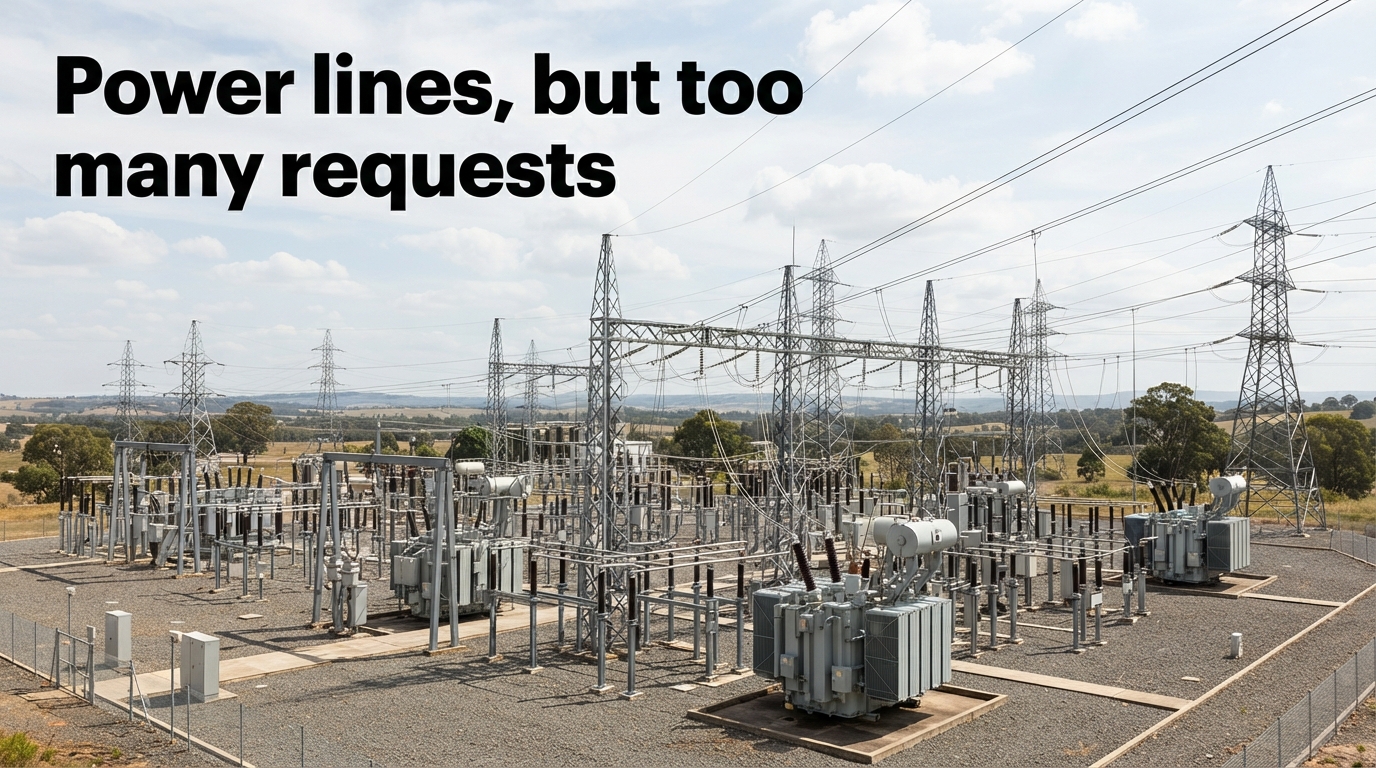
Europe has set itself a bigger electricity role, but the decisive question is whether the connection system can absorb the load.
The European Commission wants electricity to rise from about 23% of total final energy consumption today to 46% by 2040. At the same time, the International Energy Agency expects EU electricity demand to grow by around 2% a year through 2030. That means the transition is not just about switching technologies. It is about whether grids and connection procedures can keep pace with new generation and new demand.
The concrete fight is over speed, certainty, and scarce grid space. Project developers and large new electricity users want faster connections and clearer rules; grid operators and regulators have to manage limited hosting capacity and decide which requests can be processed first; and the European Commission is trying to cut delays with new connection rules. In this system, distribution system operators — the companies that run local networks — and transmission system operators — the ones that run the high-voltage backbone — are both part of the bottleneck.
The Commission says the pressure is already showing up as insufficient grid capacity for growing connection requests on both the demand and supply sides, plus delays in project implementation. Its guidance on efficient and timely grid connections is explicit that rising queues are already a problem, and that the policy response is meant to prevent, optimise and tackle those queues.
The visible symptom is backlog. The IEA says more than 2,500 GW of projects worldwide, including renewables, storage and large loads such as data centres, are stuck in grid-connection queues. It also says meeting forecast electricity demand through 2030 would require annual grid investment to rise by roughly 50% from about $400 billion today. In other words, the system is being asked to do more than it was built to do, and faster than build-out has historically happened.
Demand is rising from multiple directions at once. The IEA expects global electricity demand growth to be driven by industry, electric vehicles, air conditioning and data centres. The Commission says EU data-centre electricity use was about 70 TWh in 2024 and is expected to rise to about 115 TWh by 2030. The Commission also says Europe’s electrification rate has been stuck at roughly 23% for the past decade, even as the Clean Industrial Deal aims to push it to 32% by 2030.
Price remains a real barrier. The Commission’s 2025 competitiveness report says EU electricity prices are currently 2–3 times higher than in the US, which supports the general direction of the complaint that electricity can still be too expensive to switch to easily. But the evidence here does not support a price-first reading. Price is part of the drag; it is not the whole story.
The Commission’s answer is not just “build more wires.” It is also to rework the queue. Its guidance says regulators should set up flexible connection agreements where capacity is tight, and grid operators should provide transparency on hosting capacity and connection-request handling. DSOs are meant to publish hosting-capacity information at least quarterly, TSOs at least monthly, and users should get a status update within three months and regular updates thereafter. The package also includes a fully digital connection procedure.
The deeper diagnosis is that the bottleneck is physical and procedural at the same time. The Commission says the root causes of connection backlogs include inadequate grid planning and development, weak transparency and locational signals, and administrative constraints in handling requests. It also says planning should take account of future demand and supply on both the demand side and the generation side, not only react to existing applications.
The counter-reading is that planning quality and flexibility can matter as much as raw wire capacity. Ember argues that some transmission plans are still based on outdated wind and solar scenarios, so the system can lag policy before physical scarcity is even reached. It also says the grid challenge can be relieved through refurbishment, digitalisation, demand flexibility and storage, and that using existing corridors can reduce permitting burden in some cases. That is a serious corrective to a wires-only story. But Ember does not argue that non-wire measures eliminate the need for network expansion. They complement it.
Not a lack of targets. Not a single price gap. Not just transmission lines.
The binding constraint is whether Europe’s electricity connection system — capacity, queues, planning, transparency and connection procedures — can absorb both new supply and new demand fast enough. Flexibility and storage can ease the pressure. Better planning can reduce delay. But the transition still has to connect, physically and administratively, before it can electrify.
EU data-centre electricity use, 2024–2030
How much electricity data centres are expected to use in the EU, and how that changes from 2024 to 2030 (TWh). This chart shows EU data-centre electricity use: 70 TWh in 2024 and about 115 TWh expected by 2030. That is an increase of about 45 TWh across the period. The 2030 value is a projection, and the chart shows only the two datapoints provided by the European Commission, DG Energy: https://energy.ec.europa.eu/news/focus-data-centres-energy-hungry-challenge-2025-11-17_en. — AI-assisted analytic, built only from real cited or sourced data. Source: European Commission, DG Energy. As of 2026-07-26.
Grid investment needed vs today’s level (to meet demand through 2030)
How much extra annual electricity-grid investment the IEA estimates is needed versus today, to meet forecast EU electricity demand through 2030 (percent increase from the current level). This comparison shows estimated annual electricity-grid investment for the EU: about $400 billion today versus $600 billion needed to meet forecast demand through 2030. The required level is roughly 50% higher, or $200 billion more each year. Figures are rounded and reflect the IEA estimate in Electricity 2026 – Executive summary (published February 6, 2026): https://www.iea.org/reports/electricity-2026/executive-summary — AI-assisted analytic, built only from real cited or sourced data. Source: International Energy Agency. As of 2026-07-26.
Source recordSources / claims / limits
How this piece is framed: A system-and-queue bottleneck story: Europe has electrification targets and rising demand, but the decisive constraint is whether the electricity connection system — grid capacity, planning/development, transparency and locational signals, administrative connection procedures, queues, and flexibility/storage — can absorb both new supply and new demand fast enough to keep pace with the transition.
Charts & tables — each built only from the cited claims below, by an AI tool
- EU data-centre electricity use, 2024–2030 — from claims clm_29ecff2738, clm_02a1661bf2 · as of 2026-07-26
- Grid investment needed vs today’s level (to meet demand through 2030) — from claims clm_09dc6fbc39, clm_638d0d9086 · as of 2026-07-26
Sources
- (primary) Electricity 2026 – Executive summary — International Energy Agency — https://www.iea.org/reports/electricity-2026/executive-summary · read in full · captured 2026-07-26
- (primary) European grids — European Commission — https://energy.ec.europa.eu/topics/infrastructure/european-grids_en · read in full · captured 2026-07-26
- (primary) In focus: Data centres – an energy-hungry challenge — European Commission, DG Energy — https://energy.ec.europa.eu/news/focus-data-centres-energy-hungry-challenge-2025-11-17_en · read in full · captured 2026-07-26
- (primary) Commission notice on efficient and timely grid connection — European Commission — https://energy.ec.europa.eu/document/download/62c46b3d-0df9-42a1-a5fe-c3c71ed5f18c_en?filename=C_2025_8473_1_EN_ACT_part1_v4.pdf · read in full · captured 2026-07-26
- (primary) Putting the mission in transmission: Grids for Europe’s energy transition — Ember — https://ember-energy.org/latest-insights/putting-the-mission-in-transmission-grids-for-europes-energy-transition · read in full · captured 2026-07-26
- (primary) The 2025 Annual Single Market and Competitiveness Report — European Commission — https://single-market-economy.ec.europa.eu/document/download/e566634a-29cf-4adf-a98d-1e708c873af8_en?filename=COM_2025_26_F1_COMMUNICATION_FROM_COMMISSION_TO_INST_EN_V10_P1_3877708.PDF · read in full · captured 2026-07-26
- (primary) Putting the mission in transmission: Grids for Europe’s energy transition — Ember — https://ember-energy.org/app/uploads/2024/10/Grids-for-Europes-Energy-Transition-Report-1.pdf · read in full · captured 2026-07-26
- (secondary) Οι προκλήσεις για ηλεκτρικό μετασχηματισμό της Ευρώπης — Kathimerini Cyprus — https://www.kathimerini.com.cy/gr/prosopikotites-stin-k/oi-prokliseis-gia-ilektriko-metasximatismo-tis-eyrwpis · read in full · captured 2026-07-26
Claims, and how far we tracked each down
- [confirmed] The European Commission’s electrification plan aims to raise electricity’s share of total final energy consumption from about 23% today to 46% by 2040. · read in full (as of 2026-07-26)
- [confirmed] The IEA expects EU electricity demand to rise by around 2% per year through 2030, after growing by less than 1% in 2025. · read in full (as of 2026-07-26)
- [confirmed] The Commission says the European power networks face insufficient grid capacity for growing connection requests on both the demand and supply sides, along with delays in project implementation. · read in full (as of 2026-07-26)
- [confirmed] The Commission states that Europe’s power networks face insufficient grid capacity to meet growing connection requests on both the demand and supply sides, and also cites delays in project implementation as part of the challenge. · read in full (as of 2026-07-26)
- [confirmed] The Commission notice says rising grid connection queues are already evident and that the guidance aims to provide a toolbox of measures to prevent, optimise, and tackle lengthy grid connection queues. · read in full (as of 2026-07-26)
- [confirmed] The Commission identifies flexible connection agreements and transparency on grid hosting capacities and connection-request handling as the main policy instruments for addressing queues. · read in full (as of 2026-07-26)
- [confirmed] More than 2,500 GW of projects worldwide, including renewables, storage, and large-load projects such as data centres, remain stuck in grid-connection queues. · read in full (as of 2026-07-26)
- [confirmed] Meeting forecast electricity demand through 2030 would require annual grid investment to rise by roughly 50% from about 400 billion dollars today. · read in full (as of 2026-07-26)
- [confirmed] The IEA says global electricity demand is forecast to grow at an average annual rate of 3.6% from 2026 to 2030, driven in part by industry, EVs, air conditioning, and data centres. · read in full (as of 2026-07-26)
- [confirmed] The European Commission says data centres consumed about 70 TWh of electricity in the EU in 2024. · read in full (as of 2026-07-26)
- [confirmed] The European Commission expects EU data-centre electricity use to rise to about 115 TWh by 2030. · read in full (as of 2026-07-26)
- [likely] Electricity has remained at roughly 23% of total final energy consumption in Europe for more than a decade. · read in full (as of 2026-07-26)
- [confirmed] The seed article frames Europe’s electrification challenge as a potential ‘valley of death’ for industry because electricity remains more expensive than the fossil fuels it would replace. · read in full (as of 2026-07-26)
- [confirmed] The Commission’s 2025 competitiveness report says EU electricity prices are currently 2–3 times higher than in the US, supporting the general direction of the seed article’s price-competitiveness argument. · read in full (as of 2026-07-26)
- [confirmed] The notice specifies implementation details: DSOs should provide hosting-capacity information at least quarterly, TSOs at least monthly, and grid users should get a connection-status update within three months and regular updates thereafter; it also mentions a fully digital connection procedure option. · read in full (as of 2026-07-26)
- [confirmed] The Commission says the main root causes of grid connection backlogs are inadequate grid planning and development, lack of transparency and locational signals, and grid connection procedures slowed by speculative applications, non-digitalised processes and administrative constraints. · read in full (as of 2026-07-26)
- [confirmed] The Commission says grid operators should plan for future demand and generation on both the demand side and the generation side, not only react to existing connection requests. · read in full (as of 2026-07-26)
- [confirmed] Ember’s 2024 Europe grid report argues that many transmission plans are still based on outdated scenarios, so grid planning often lags policy updates rather than simply failing from a lack of raw engineering capacity. · read in full (as of 2026-07-26)
- [confirmed] Ember says the grid challenge can be addressed in two complementary ways: physical expansion and better use of existing networks through refurbishment, digitalisation, demand flexibility, and storage. · read in full (as of 2026-07-26)
- [confirmed] Ember says some transmission plans are based on outdated wind and solar scenarios, so planning can lag policy before physical scarcity becomes binding. · read in full (as of 2026-07-26)
- [confirmed] Ember says grid pressure can be eased through refurbishment, digitalisation, demand flexibility and storage, and that using existing corridors can reduce permitting needs in some cases. · read in full (as of 2026-07-26)
- [confirmed] Ember explicitly says that using existing line corridors can reduce the need for additional permitting in some cases, but new corridors may still be unavoidable where new renewable supply needs to be connected. · read in full (as of 2026-07-26)
Where we hit a limit / what to double-check
- Figures we could not match to our stored evidence — worth confirming against the source (which may state them exactly), and note live sources move: 32%.