
DR Congo bans raw copper and cobalt exports to force refining at home
Most copper already leaves as finished metal and the biggest concentrate mine now smelts on site, so the near-term global squeeze is narrow; whether the ban sticks hinges on undefined 'strategic' waivers and chronic power shortages.


What happenedOn June 29, 2026, DR Congo's mines, foreign trade and economy ministers banned exports of copper and cobalt concentrates — partly processed ore needing smelting — effective immediately, repealing the 2023 waiver system and adding a by-product tax after three months.
Why it mattersCongo mines about three-quarters of the world's cobalt and is the No. 2 copper producer, so a border rule can move battery and wiring prices, but most copper already leaves as finished metal and the biggest concentrate source now smelts on site, limiting near-term shock.
Still openWhether the mines minister will grant broad 'strategic' waivers as in 2013-2023 or enforce strictly despite a 1,000MW power deficit and limited smelter capacity — no waiver criteria or industry responses had been published as of Aug. 6.
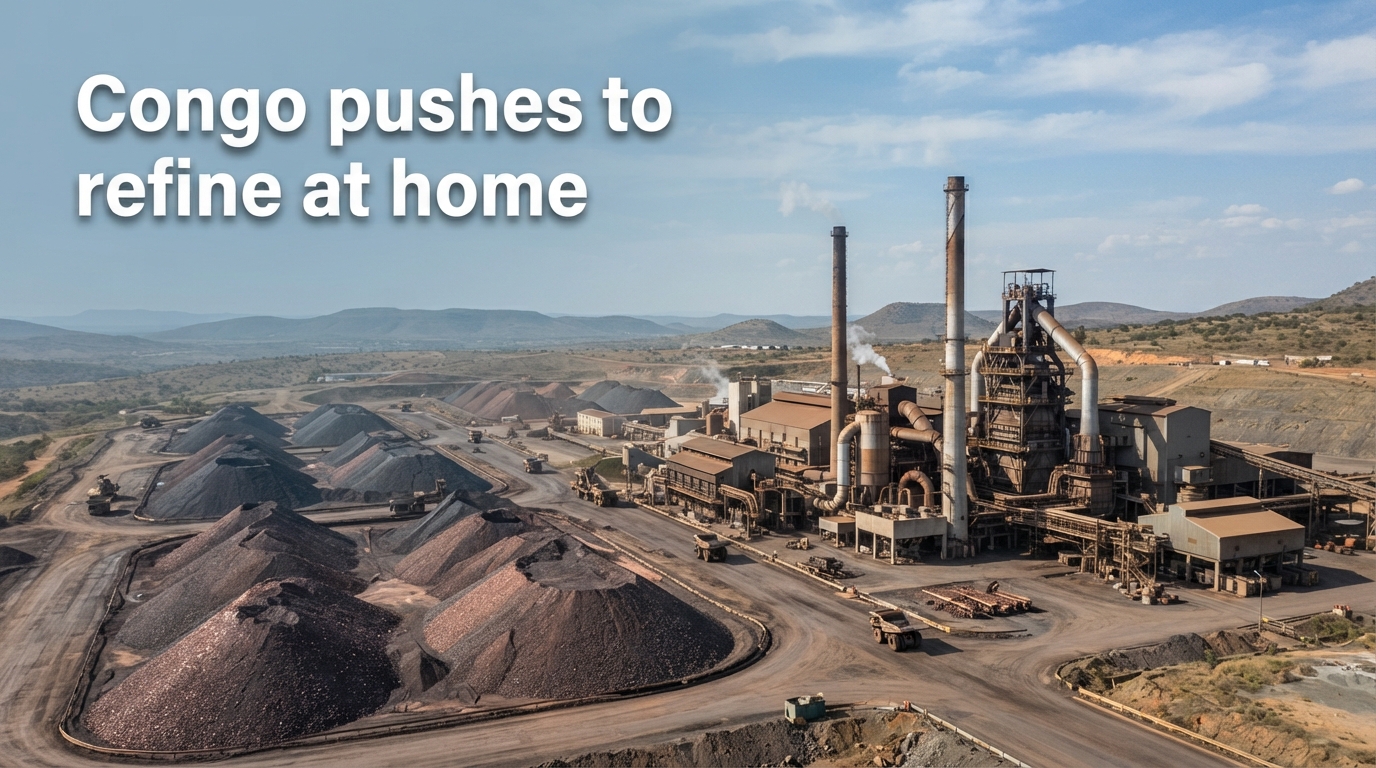
On June 29, 2026, three ministers in the Democratic Republic of Congo — Mines Minister Louis Kabamba Watum, Foreign Trade Minister Julien Paluku Kahongya and Economy Minister Daniel Mukoko Samba — signed a joint order banning exports of copper and cobalt concentrates — partly processed ore that must still be smelted and refined before it can be used in wiring, batteries and electronics — effective immediately. The move matters because Congo controls 73-84% of world cobalt mine output and is the world's second-largest copper producer after Chile, so a border rule there can move prices for batteries and electrification; copper on the London Metal Exchange, the London benchmark where global prices are set, rose as much as 1.8% to $14,369.50 a tonne after Reuters reported the order. Whether the ban actually bites depends on an undefined escape hatch — one-year "strategic" waivers the mines minister may grant — and on chronic power shortages that have gutted similar bans for 12 years; no waiver criteria or industry responses had been published as of August 6.
What the order does
The order says "the export of copper and cobalt concentrates is prohibited," takes effect immediately, repeals the August 2023 framework that allowed annual renewable exemptions, and replaces it with a broader regime for mineral exports.
It keeps a discretionary waiver: the mines minister may grant one-year export exemptions in "strategic" circumstances, without defining what counts as strategic. A separate tax change follows after a three-month transition: for economically significant mining by-products — trace and ultra-trace minerals recovered during refining, such as germanium — royalties will be charged alongside the main mineral using a 55% valuation coefficient. The stated motivation is "the need to encourage mining operators to market or export commercial mineral products with high added value."
The full text has not appeared on the mines ministry website or in the official gazette as of August 6; the most authoritative public record is Reuters' direct review of the order, which provided verbatim language for the prohibition, signatories, immediate effect, waiver provision, tax transition and repeal.
Why Congo has leverage
The Democratic Republic of Congo, a Central African country of about 100 million people, dominates the two metals at the heart of electrification. It mined about 76% of world cobalt in 2024, according to the U.S. Geological Survey, with other estimates for 2025 putting its share at 73-84%, far ahead of Indonesia at 10-14%. It exported about 3.4 million tonnes of copper in 2025, up nearly 10% from 3.1 million tonnes in 2024, according to provisional Ministry of Mines figures cited at a mining conference and cross-checked in cabinet minutes chaired by President Félix Tshisekedi — provisional, not yet the central bank's final annual table.
That scale translates into fiscal weight. Mining accounts for more than 90% of export revenue — copper alone was about three-quarters of export earnings in 2023 and cobalt more than 10% — and extractives account for about 39% of GDP and 42% of fiscal revenues, according to French Treasury and multilateral data. Copper, prized for conductivity and durability, is the wiring for grids, motors and data centers; demand is projected to rise from 28 million tonnes in 2025 to 42 million by 2040. Cobalt is a cathode material for most lithium-ion batteries, with about 76% of demand from batteries and more than 13kg per electric-vehicle battery, though cobalt-free LFP batteries now cover nearly half the EV market, creating substitution risk if prices stay high.
Because China refines about 78.6% of the world's cobalt, largely from Congo-origin hydroxide, and Zambia's smelters depend on Congolese concentrates for more than 60% of bilateral trade, a concentrate rule in Kinshasa squeezes feedstock to custom smelters abroad and tightens treatment and refining charges even before mine output changes.
Why the immediate bite is narrower than the headline
A "copper export ban" sounds like 3.4 million tonnes at risk. Most of that copper already leaves refined.
Official data for the first quarter of 2026 show Congo exported 696,725 tonnes of copper cathodes — finished metal ready for factories — compared with 53,926 tonnes of copper concentrates containing 18,863 tonnes of copper metal, plus 51,940 tonnes of cobalt hydroxides. Resource Matters estimates almost 80% of copper exported in the last five years was already metal. Glencore, the Swiss miner and trader that operates Mutanda and Kamoto in Congo, only exports hydroxide and cathodes, and is largely unaffected. The parallel cobalt control — a separate 96.6-kilotonne export quota for 2026-2027 run by ARECOMS, the regulator for strategic minerals (87kt routine at 7,250 tonnes a month plus 9.6kt strategic) — already showed how border allocations, not mine output, set accessible supply: 2025 showed a 19kt global surplus in total supply but a 96kt deficit once export caps were applied.
Shanghai Metals Market, the Chinese metals analytics firm, called the June 29 order more a reiteration and tightening of existing approval restrictions than a sudden halt, and judged limited additional impact on short-term global concentrate trade for that reason. The residual concentrate stream still matters for custom smelters, but it is a sliver, not the whole flow.
The test case: Kamoa-Kakula now smelts most of its own ore
The mine most exposed is also the most insulated. Kamoa-Kakula, the giant copper complex 25km southwest of Kolwezi operated as a joint venture between Canada's Ivanhoe Mines, China's Zijin Mining and the Congolese government, was the source of most previously exported concentrates — 388,800 tonnes of contained copper in 2025 and 590,000 tonnes of concentrates under exemptions in 2023.
Since late 2025 it has run Africa's largest copper smelter on site: a 500,000-tonne-per-year direct-to-blister smelter that makes 99.7%-pure copper anodes. In the second quarter of 2026 it operated at about 60% of design capacity, producing 62,072 tonnes of copper in anode (64,328 tonnes including blister and slag toll-treated at the Lualaba Copper Smelter in Kolwezi) and 112,307 tonnes of high-strength sulphuric acid.
That changes the economics. Logistics charges in Q2 averaged $0.24 per pound, about one-third of the $0.70 per pound before the smelter when concentrate containing 35-40% copper was trucked out. Sulphuric acid sales — 119,603 tonnes sold at $465 per tonne in Q2, with July-August contracts set around $840 — generated $0.39 per pound in by-product credits, largely offsetting $0.41 per pound in smelter operating costs. Ivanhoe tightened 2026 guidance to 290,000-310,000 tonnes of copper in anode, blister or slag (from 290,000-330,000) and kept 2027 at 380,000-420,000, with second-half 2026 output set to rise about 28% versus the first half as mining rates increase 30% and up to 10,000 tonnes of inventory is destocked. Full 500,000-tonne smelter capacity is expected in 2028, meaning the often-cited 164,000-tonne-per-year concentrate exposure to 2029 will be progressively smelted domestically.
Excess concentrate not handled on site is toll-treated at Lualaba — the only major domestic facility able to absorb bulk concentrates, with capacity for 400,000 tonnes of concentrate and 120,000 tonnes of blister a year.
How miners and traders can adapt — and what else changes
For the remaining concentrate exporters, three paths exist, none guaranteed: seek a one-year strategic waiver from the mines minister, toll-process at Lualaba, or accelerate building their own smelter. Traders must also track the separate cobalt quota, where shipments are counted against ceilings and delays in the first quarter of 2026 already showed allocation friction.
The new by-product tax, if audited and enforced, raises fiscal capture from often under-declared trace minerals but also raises royalty burdens; its methodology and revenue uplift are unverified and the three-month transition had not yet taken effect in early August. Zambia's own 5% import duty on concentrates, imposed in January 2019, already reshaped flows — Eurasian Resources Group closed its Chambishi smelter in Zambia that year and stockpiled Congolese concentrate in bonded warehouses.
Will the ban stick? The 2019 U-turn looms large
Congo has banned concentrate exports before — in the 2002 Mining Code, specifically in 2013, again in 2019 and 2023 — and each time granted broad waivers citing insufficient domestic smelting capacity and electricity deficits. Between 2013 and 2023 at least eight moratoria or extensions were issued. The 2018 Mining Code set a March 2021 deadline after which extensions required parliamentary approval, but case-by-case waivers continued, for example for Sicomines until 2022.
The precedent that tests credibility came in 2019. A mid-February ban was lifted within a month, in a March 20 letter from then Mines Minister Henri Yav Mulang to the Federation des Entreprises du Congo (FEC), the main business lobby, after the FEC cited the energy deficit. The government shifted to six-month reviews, and producer sources told Fastmarkets at the time that ERG's Frontier mine — which produced 102,058 tonnes of copper in concentrate in 2018 — and Sicomines concentrates "can't be processed in any local facility" and were exempted, with photos showing Congolese concentrates still in Zambia bonded warehouses despite the ban. The Chamber of Mines president said he was not aware of the ban and could not comment, and the mines ministry did not respond to requests.
The same constraints remain. State utility SNEL estimates a 1,000-megawatt deficit for mining, and outside Lualaba there is barely any facility that can take bulk concentrates. As of August 6, no public statements had been found from the Congolese Chamber of Mines, FEC, Zambia's mines ministry, China's smelter association, or major operators including CMOC, Zijin, ERG and Huayou responding to the June 29 order — an information vacuum that leaves whether waivers will be broad or narrow genuinely unknown, not a confirmation of strict enforcement.
What Congo stands to gain — and risk
From Kinshasa's perspective, after 12 years of waivers, exporting low-value concentrates lets foreign smelters capture margin that could fund domestic industry. With mining about 25% of GDP and critical minerals' share rising to 27% in 2025, capturing more value from trace by-products and forcing refining at home is a developmental imperative, not just a trade tactic. The February 2025 cobalt export suspension — imposed after prices collapsed 75% from 2022 to 2024 to about $9.75 per pound, cutting cobalt royalties from $715 million in 2022 to $409 million in 2023 despite higher output — showed the same pricing-power logic before it was replaced by the quota in October 2025.
From miners' and the FEC's perspective, a ban without reliable power and smelters risks stockpiling, smuggling or production cuts, deters investment through regulatory surprise, and penalizes operators who already invested in cathodes and hydroxide while leaving residual concentrate exporters needing predictable waivers or tolling. From buyers' perspective — especially Chinese refiners and Zambian smelters — even a narrow squeeze, combined with the 96.6kt cobalt quota equal to about 35% of global demand, tightens an already strained treatment-charge market.
Market skeptics and insulated operators argue the headline overstates near-term shock for exactly the reasons above: most copper already leaves as metal, and Kamoa-Kakula's smelter halves logistics costs and offsets its own operating costs with acid sales. That view does not mean zero impact — the residual concentrate feedstock to China and Zambia still matters — but it reframes the order as leverage and signal rather than immediate supply cutoff.
Part of a wider squeeze on raw exports
Congo is not alone. More than 50% of energy-related minerals are now subject to export controls, according to the International Energy Agency, expanding from raw ore to processing technology. Indonesia banned nickel ore exports in 2020, attracting Chinese high-pressure acid leach investment and making Indonesia the world's second-largest cobalt producer via mixed hydroxide precipitate; it later tied export permits to smelter progress and then to production quotas. Nigeria, Zambia, Guinea and Zimbabwe have recently restricted unrefined exports of cocoa, copper, gold and lithium concentrates respectively. Indonesia's nickel ban drew a World Trade Organization dispute from the European Union — a precedent, not a prediction, for Congo.
For a reader watching whether battery and copper costs rise, the markers are concrete: whether the mines minister publishes criteria for "strategic" waivers and grants them broadly as in 2013-2023 or enforces strictly; whether power and smelter capacity — Lualaba's 120kt blister and Kamoa-Kakula's ramp to 500kt by 2028 — can absorb the remaining concentrate without stockpiling; and how treatment charges and the cobalt quota allocations move in the next two quarters. The ban gives Congo real border-control leverage over a concentrated supply chain; history suggests that leverage will be negotiated waiver by waiver, not imposed overnight.
Source recordSources / claims / limits
How this piece is framed: Leverage vs. limits: a dominant supplier tightens a long-waived rule to force domestic refining — big structural power, narrow immediate bite, enforcement still to be proven
Sources
- (primary) Republique democratique du Congo (RDC) - Le Moci fiche pays — Le Moci / DG Tresor — https://www.lemoci.com/fiche-pays/congo · read in full · captured 2026-08-06
- (primary) Ivanhoe Mines Issues 2026 Second-Quarter Financial Results, Overview of Operations and Exploration Activities — https://www.ivanhoemines.com/news-stories/news-release/ivanhoe-mines-issues-2026-second-quarter-financial-results-overview-of-operations-and-exploration-activities · read in full · captured 2026-08-06
- (primary) Mineral Commodity Summaries 2025 — U.S. Geological Survey — https://pubs.usgs.gov/periodicals/mcs2025/mcs2025.pdf · read in full · captured 2026-08-06
- (primary) EXCLUSIVE: Congo bans exports of copper, cobalt concentrates, official order says — Reuters — https://www.reuters.com/world/africa/congo-bans-exports-copper-cobalt-concentrates-official-order-says-2026-08-06/ · read in full · captured 2026-08-06
- (primary) Congo president orders probe into copper and cobalt export revenues, document shows — Reuters — https://www.reuters.com/world/africa/congo-president-orders-probe-into-copper-cobalt-export-revenues-document-shows-2026-04-28 · read in full · captured 2026-08-06
- (primary) Ivanhoe Mines Announces First Anode Production from Kamoa-Kakula Copper Smelter — https://www.ivanhoemines.com/news-stories/news-release/ivanhoe-mines-announces-first-anode-production-from-kamoa-kakula-copper-smelter · read in full · captured 2026-08-06
- (primary) Global Critical Minerals Outlook 2025 - Executive Summary — International Energy Agency — https://www.iea.org/reports/global-critical-minerals-outlook-2025/executive-summary · read in full · captured 2026-08-06
- (primary) Strengthening critical mineral supply chains by countering China's dominance — U.S. International Development Finance Corporation — https://www.dfc.gov/investment-story/strengthening-critical-mineral-supply-chains-countering-chinas-dominance · read in full · captured 2026-08-06
- (primary) RDC : le cuivre en hausse de 4,89% en 2024, le cobalt chute de 26,57% (BCC Note de conjoncture) — Actualite.cd / Banque Centrale du Congo — https://actualite.cd/2024/12/31/rdc-le-cuivre-en-hausse-de-489-en-2024-le-cobalt-chute-de-2657 · read in full · captured 2026-08-06
- (secondary) Congo's copper exports jump 10% as Chinese firms lead growth — Business Insider Africa — https://africa.businessinsider.com/local/markets/congos-copper-exports-jump-10-as-chinese-firms-lead-growth/vben8wq · read in full · captured 2026-08-06
- (secondary) DRC U-turns on cobalt, copper concentrate export ban; says could reimpose — Fastmarkets — https://www.fastmarkets.com/insights/drc-u-turns-on-cobalt-copper-concentrate-export-ban-says-could-reimpose · read in full · captured 2026-08-06
- (secondary) EXCLUSIVE: DRC bans cobalt, copper concentrate exports, cutting off Zambia trade — Fastmarkets — https://www.fastmarkets.com/insights/exclusive-drc-bans-cobalt-copper-concentrate-exports-cutting-off-zambia-trade · read in full · captured 2026-08-06
- (secondary) Economics: Sub-Saharan Africa — Council on Foreign Relations — https://www.cfr.org/education/learn/reading/economics-sub-saharan-africa · read in full · captured 2026-08-06
- (secondary) Top 10 Cobalt Producers by Country — Investing News Network — https://investingnews.com/where-is-cobalt-mined · read in full · captured 2026-08-06
- (secondary) Ivanhoe sees Congo copper output rising in second half 2026 — Mining.com via Reuters — https://www.mining.com/web/ivanhoe-sees-congo-copper-output-rising-in-second-half-2026 · read in full · captured 2026-08-06
- (secondary) DR Congo: Government bans export of copper and cobalt concentrates — Africanews — http://www.africanews.com/2026/08/06/dr-congo-government-bans-export-of-copper-and-cobalt-concentrates/ · read in full · captured 2026-08-06
- (secondary) DRC concentrate export ban may tighten global copper, cobalt supply — MINING.COM — https://www.mining.com/drc-concentrate-export-ban-may-tighten-global-copper-cobalt-supply/ · read in full · captured 2026-08-06
- (secondary) SMM News Flash: DRC signs copper, cobalt concentrate export ban - detailed explanation — Shanghai Metals Market (SMM) — https://news.metal.com/en/newscontent/104046617-smm-news-flash-drc-signs-copper-cobalt-concentrate-export-ban-detailed-explanation · read in full · captured 2026-08-06
- (secondary) Congo Mines 73% of Cobalt. Its Export Cap Reset the Market — EBC Financial Group — https://www.ebc.com/forex/congo-cobalt-export-cap-market · read in full · captured 2026-08-06
- (secondary) EXCLUSIVE: Congo bans exports of copper, cobalt concentrates, official order says — Reuters via WTVB (syndicated Reuters dispatch) — https://wtvbam.com/2026/08/06/exclusive-congo-bans-exports-of-copper-cobalt-concentrates-official-order-says · read in full · captured 2026-08-06
- (secondary) World's largest cobalt producer bans copper and cobalt concentrate exports, hitting Chinese, Canadian and Swiss mining giants — Business Insider Africa — https://africa.businessinsider.com/local/markets/worlds-largest-cobalt-producer-bans-copper-and-cobalt-concentrate-exports-hitting/5455zpq · read in full · captured 2026-08-06
- (secondary) From raw ore to local transformation: Pathways for increased value addition — Resource Matters — https://www.resourcematters.org/app/uploads/2026/04/White-paper-English-version-05.05-26.pdf · full text not obtained — used its summary
- (secondary) One country holds an estimated twenty-four trillion dollars in mineral wealth — SpaceDaily (aggregating USGS) — https://spacedaily.com/d-one-country-holds-an-estimated-twenty-four-trillion-dollars-in-mineral-wealth-beneath-its-soil-cobalt-and-copper-the-very-metals-that-power-the-phones-and-electric-cars-of-the-modern-world · full text not obtained — used its summary
Claims, and how far we tracked each down
- [confirmed] No public 2026 statements found from Congolese Chamber of Mines (Chambre des Mines RDC), FEC, Zambian Ministry of Mines, or Chinese smelter association (CNIA) responding to June 29 order as of Aug 6 2026; 2019 Chamber president Simon Tamu Waku told Fastmarkets he was 'not aware of the ban' and could not comment, and DRC Ministry of Mines did not respond to requests - indicating information vacuum and that waiver criteria/industry negotiation remains opaque. No direct 2026 statements located for CMOC, Zijin, ERG, Huayou either. · read in full (as of 2026-08-06)
- [likely] The new by-product tax applies to trace and ultra-trace minerals recovered during refining using a 55% valuation coefficient, with royalties charged alongside those on the main mineral · read in full (as of 2026-08-06)
- [confirmed] The order introduces a new tax regime for economically significant mining by-products with a three-month transition period · read in full (as of 2026-08-06)
- [confirmed] Mining accounts for over 90% of DR Congo's export revenue, with copper accounting for nearly three-quarters of export earnings in 2023 and cobalt over 10% · read in full (as of 2026-08-06)
- [confirmed] The mines minister may grant one-year export waivers under strategic circumstances · read in full (as of 2026-08-06)
- [confirmed] Ivanhoe Mines Q2 2026 results show Kamoa-Kakula is largely insulated from concentrate ban: on-site 500,000 tpa direct-to-blister smelter operating at ~60% capacity since mid-February, produced 62,072t copper in anode in Q2 (64,328t total including LCS blister/slag), logistics costs ~$0.24/lb vs ~$0.70/lb pre-smelter (one-third), and sulphuric acid by-product credits $0.39/lb largely offset $0.41/lb smelter operating costs; management prioritizes processing Phase 1-3 concentrates on-site with excess toll-treated at Lualaba Copper Smelter. · read in full (as of 2026-08-06)
- [confirmed] Historical precedent suggests high waiver likelihood: February 2019 concentrate ban was lifted within one month (March 20 2019 letter to FEC) after Federation des Entreprises du Congo (FEC) cited energy deficit, with government shifting to six-month reviews; DRC producer sources told Fastmarkets that ERG Frontier (102,058t contained copper in 2018) and Sicomines concentrates 'can't be processed in any local facility' and were exempted, and photos showed DRC concentrates still in Zambia bonded warehouses despite ban. · read in full (as of 2026-08-06)
- [confirmed] DR Congo is the world's largest cobalt producer, accounting for about 76% of world cobalt mine production in 2024 (USGS) and 73-84% in 2025 depending on source · read in full (as of 2026-08-06)
- [confirmed] Copper and cobalt are critical for electrification, grid expansion, and lithium-ion batteries for electric vehicles and electronics · read in full (as of 2026-08-06)
- [confirmed] China dominates cobalt refining, producing about 78.6% of refined cobalt in 2025 and about 70%+ of global refined supply, largely from DRC-origin hydroxide · read in full (as of 2026-08-06)
- [confirmed] Separately from the concentrate ban, DR Congo operates a cobalt export quota system for 2026-2027 totaling 96.6kt (87kt routine allocations at 7,250 tonnes/month plus 9.6kt strategic quota controlled by ARECOMS) · read in full (as of 2026-08-06)
- [confirmed] Most DR Congo copper is already exported as refined metal: 696,725 tons of copper cathodes vs 53,926 tons of copper concentrates (18,863 tons contained copper) in Q1 2026, plus 51,940 tons cobalt hydroxides · read in full (as of 2026-08-06)
- [confirmed] The concentrate export ban takes effect immediately · read in full (as of 2026-08-06)
- [confirmed] After Reuters reported the ban, benchmark three-month copper on the London Metal Exchange rose as much as 1.8% to $14,369.50 per metric ton · read in full (as of 2026-08-06)
- [likely] Glencore and other large operators largely unaffected by concentrate ban: Glencore only exports hydroxide/cathodes from Mutanda/Kamoto, and under cobalt quota regime is prioritizing copper over cobalt; SMM and Reuters note most DRC copper already exported as cathodes/hydroxide, so ban targets narrow residual concentrate stream, not diversified majors' core exports. · read in full (as of 2026-08-06)
- [likely] DR Congo exported about 3.4 million tons of copper in 2025, up nearly 10% from 3.1 million tons in 2024 · read in full (as of 2026-08-06)
- [confirmed] Ivanhoe maintained 2026 guidance 290,000-310,000t copper in anode/blister/slag (tightened from 290-330kt) and 380,000-420,000t for 2027, with H2 2026 output set to rise ~28% vs H1 (135,745t H1) via 30% higher mining rates and destocking up to 10,000t inventory; smelter ramp to full 500ktpa expected 2028, implying Kamoa-Kakula's 164kt/year concentrate exposure cited for 2029 is overstated for near-term and will be progressively smelted domestically. · read in full (as of 2026-08-06)
- [confirmed] DR Congo issued a joint ministerial order dated June 29, 2026 banning export of copper and cobalt concentrates · read in full (as of 2026-08-06)
- [confirmed] DR Congo is the world's second-largest copper producer after Chile · read in full (as of 2026-08-06)
- [confirmed] Zambian smelter/trade counter-perspective: DRC ban cuts off Zambia trade where copper concentrates make up >60% of bilateral trade; Zambia's own 5% import duty on concentrates (Jan 2019) already forced ERG to close Chambishi smelter and stockpile DRC concentrate in bonded zones; Lualaba smelter (400kt concentrate / 120kt blister capacity) is only major DRC facility able to absorb bulk concentrates, leaving limited domestic capacity to justify strict ban without waivers. · read in full (as of 2026-08-06)
- [confirmed] The June 29 order repeals the 2023 order and its exemptions and replaces it with a broader framework governing mineral exports and by-product taxation · read in full (as of 2026-08-06)
- [likely] SMM analyst assessment: June 29 ban may have limited additional impact on short-term global copper concentrate trade because DRC exports were already subject to strict approval/quota restrictions and Kamoa-Kakula - source of most previously exported concentrates (388,800t contained copper in 2025) - now has local smelting capacity (62,100t anode in Q2 2026); policy is reiteration/tightening of existing controls rather than sudden complete halt, though it signals rising resource protectionism. · read in full (as of 2026-08-06)
- [confirmed] The order was signed by Mines Minister Louis Kabamba Watum, Foreign Trade Minister Julien Paluku Kahongya and Economy Minister Daniel Mukoko Samba · read in full (as of 2026-08-06)
- [confirmed] DR Congo's cobalt export suspension from February 2025 (extended twice) was replaced in October 2025 by the quota system, after prices fell below $10 per pound · read in full (as of 2026-08-06)
- [confirmed] DR Congo has maintained a nominal ban on copper and cobalt concentrate exports since 2013 but repeatedly issued waivers and moratoria due to insufficient domestic smelting capacity and electricity deficits · read in full (as of 2026-08-06)
Where we hit a limit / what to double-check
- We did not obtain the full text of From raw ore to local transformation: Pathways for increased value addition (https://www.resourcematters.org/app/uploads/2026/04/White-paper-English-version-05.05-26.pdf); claims resting on it are from its summary — you may be able to reach it directly.
- We did not obtain the full text of One country holds an estimated twenty-four trillion dollars in mineral wealth (https://spacedaily.com/d-one-country-holds-an-estimated-twenty-four-trillion-dollars-in-mineral-wealth-beneath-its-soil-cobalt-and-copper-the-very-metals-that-power-the-phones-and-electric-cars-of-the-modern-world); claims resting on it are from its summary — you may be able to reach it directly.
- Figures we could not match to our stored evidence — worth confirming against the source (which may state them exactly), and note live sources move: 14%, 39%, 42%, 80%, 25%, 27%, 75%, 50%.